
Low Speed vs. Heavy Duty Shredders: Torque, Output Size, and Technical Selection Parameters
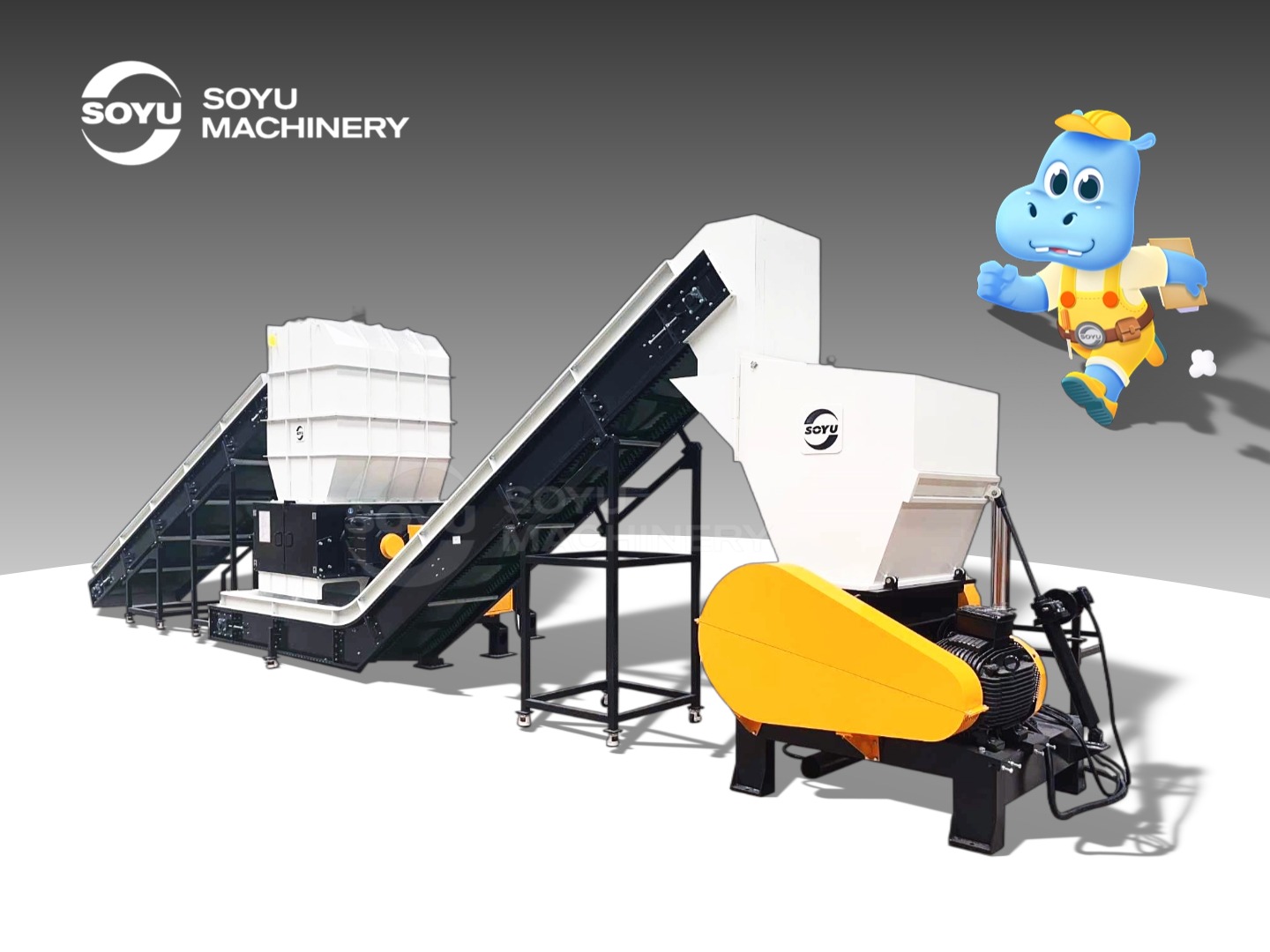
Primary reduction is a torque problem before it is a power problem. Image: Soyu Machinery.
A low speed high torque shredder and a heavy duty industrial shredder are not two points on the same scale, and they are not interchangeable choices. One describes a drivetrain strategy. The other describes a duty class. Confusing the two is the single most common cause of a primary reduction line that underperforms its specification.
In primary reduction, the shredder has one job: reduce the incoming stream to a particle size the next stage can accept, at a cost per ton the operation can sustain. Two machines with identical motor nameplates can produce very different results on the same material, because motor kilowatts say nothing about how torque reaches the cutting shaft, how the cutters are arranged, or what the sizing screen allows through.
This guide separates the two terms, explains what actually controls output particle size and energy consumption per ton, and sets out the technical selection parameters that determine whether a machine belongs in the primary reduction position on your stream. It is written for procurement engineers, project managers and recycling operators making a decision-stage evaluation, and it uses only specifications that can be traced to a source.
Why "More Power" Is the Wrong Selection Variable
The first problem is definitional. In most shredder specifications, the headline number is installed motor power in kilowatts. Buyers compare that number across machines and assume it represents cutting capability. It does not. Installed power is electrical capacity. The cutting force available at the shaft is a function of installed power, gearbox ratio and rotational speed working together. The same motor can be geared to turn fast with modest torque, or slowly with high torque.
That mismatch produces two predictable failure patterns:
- High speed, low torque on tough material. The cutters ride over the material instead of shearing it. Energy goes into impact, heat and noise rather than size reduction. Cutter edges wear quickly, dust and fines increase, and throughput falls below the rated figure even though the motor is at full load.
- Low speed, high torque on oversized infeed. The machine has the force to shear, but the inlet envelope cannot accept the largest single item. The result is bridging, stall, overload trips and unplanned downtime — not a power problem, an infeed-design problem.
The second problem is the assumption that shaft speed determines output size. It does not. Output particle size is set by cutter geometry and, in most configurations, by a sizing screen or screen gap at the discharge. A low-speed machine with a coarse discharge will not deliver fine output. A high-speed machine with a fine screen will deliver the size but generate more impact-driven fines, dust and heat in the process. Speed and torque determine how material is broken. Screen and cutter geometry determine what size comes out.
Industry Background: Volume, Configuration Split, and the Regulatory Floor
Industrial shredding is a mature, growing equipment category with a downstream demand base that is not going away. Published estimates vary by study scope — one widely cited figure puts the global industrial shredder market at approximately USD 1.28 billion in 2024, projected to reach USD 1.65 billion by 2032, while another study using a broader definition places it at USD 5.1 billion. The divergence is a scope difference rather than a contradiction, and it is a useful reminder that buyers should read specifications, not headline market numbers.
| Reference metric | Value | Source |
|---|---|---|
| Global industrial shredder market, 2024 | USD 1.28 billion | Intel Market Research |
| Projected global market, 2032 | USD 1.65 billion | Intel Market Research |
| Asia Pacific share of metal shredder machine revenue, 2024 | 39.0% | Grand View Research |
| Twin shaft share of the metal shredder market, 2024 | 35.0% | Grand View Research |
| Commercial four shaft shredder market, 2025 | USD 0.51 billion | Dataintelo |
| Four shaft commercial segment CAGR to 2034 | 5.8% | Dataintelo |
| Refuse Derived Fuel market using shredded MSW, 2023 | USD 4.6 billion | Market.us |
| Combined share of the top five global industrial shredder players | Approximately 38% | Intel Market Research |
Two things stand out for a decision-stage buyer. First, twin shaft and four shaft configurations — the multi-shaft, low-speed family — carry a large share of the metal shredding segment, which indicates that the market has already settled on low-speed high-torque designs for primary reduction of tough material. Second, the supplier landscape is concentrated: the top five global players (Doppstadt, Vecoplan, Untha, Lindner Recyclingtech and Komptech, per Intel Market Research) hold roughly 38% of the market, which leaves substantial room for specialist manufacturers with flexible configuration capabilities.
Regulation sets a common floor regardless of machine class. EN ISO 13857:2019 defines safety distances intended to prevent hazard zones from being reached by limbs, and it applies to shredder guarding whether the machine runs at low shaft speed with high torque or at standard speed. A slower shaft does not lower the compliance requirement — and when the feed stream contains batteries, e-waste or solvent-contaminated packaging, the explosion and fire risk profile rises.
Torque, Speed, and Shaft Geometry: The Core Mechanical Difference
What "low speed high torque" actually describes
Low speed high torque is a drivetrain strategy, not a category of machine. Rotational speed at the cutting shaft is deliberately held low, and the gearbox multiplies motor torque so the cutter edge bites and shears rather than hammers. The mechanical consequences are consistent: less impact, less heat generated in the cut zone, less airborne dust and fines, and a slower wear rate on cutting edges. The trade-off is throughput per shaft revolution, which is recovered through shaft width, cutter count and infeed design rather than through speed.
This is why the strategy dominates in primary reduction of heterogeneous, contaminated or tough streams. When a shredder has to survive tramp metal, mixed density and moisture without stalling, a slow shaft with high torque is more tolerant than a fast shaft with low torque.
What "heavy duty" actually describes
Heavy duty is a duty class. It describes structural and drive robustness: oversized shafts and bearings, a reinforced housing, a heavier gearbox, higher tolerance for shock loads, and a design intended for continuous rather than intermittent operation. A heavy duty industrial shredder can be built as a low-speed high-torque machine or as a standard-speed machine — the label says how much abuse the machine absorbs, not how fast it turns.
In practice, the two descriptions usually appear together on the same specification sheet, and that is correct. A heavy duty and low-speed high-torque machine is the normal answer for demanding primary reduction. A heavy duty machine running at standard speed is appropriate when throughput per hour matters more than fines control or when the material is easier to reduce.
Single, double and four shaft configurations
Shaft count is the third variable, and it interacts with both of the above. A single shaft shredder uses one rotor with a hydraulic ram feeding material against a counter knife and sizing screen, a layout suited to relatively homogeneous streams; Soyu Machinery's SR1400 single shaft shredder, for example, is documented with a rotor speed of 73 rpm and hydraulic ram feed. A double shaft (twin shaft) shredder uses two counter-rotating shafts fitted with hooked cutters, which tolerate mixed, bulky and contaminated feed far better — the configuration that held a 35.0% revenue share of the 2024 metal shredder market. A four shaft shredder adds a second pair of counter-rotating shafts, giving finer control over discharge size and supporting the growth reflected in the USD 0.51 billion commercial four shaft segment.
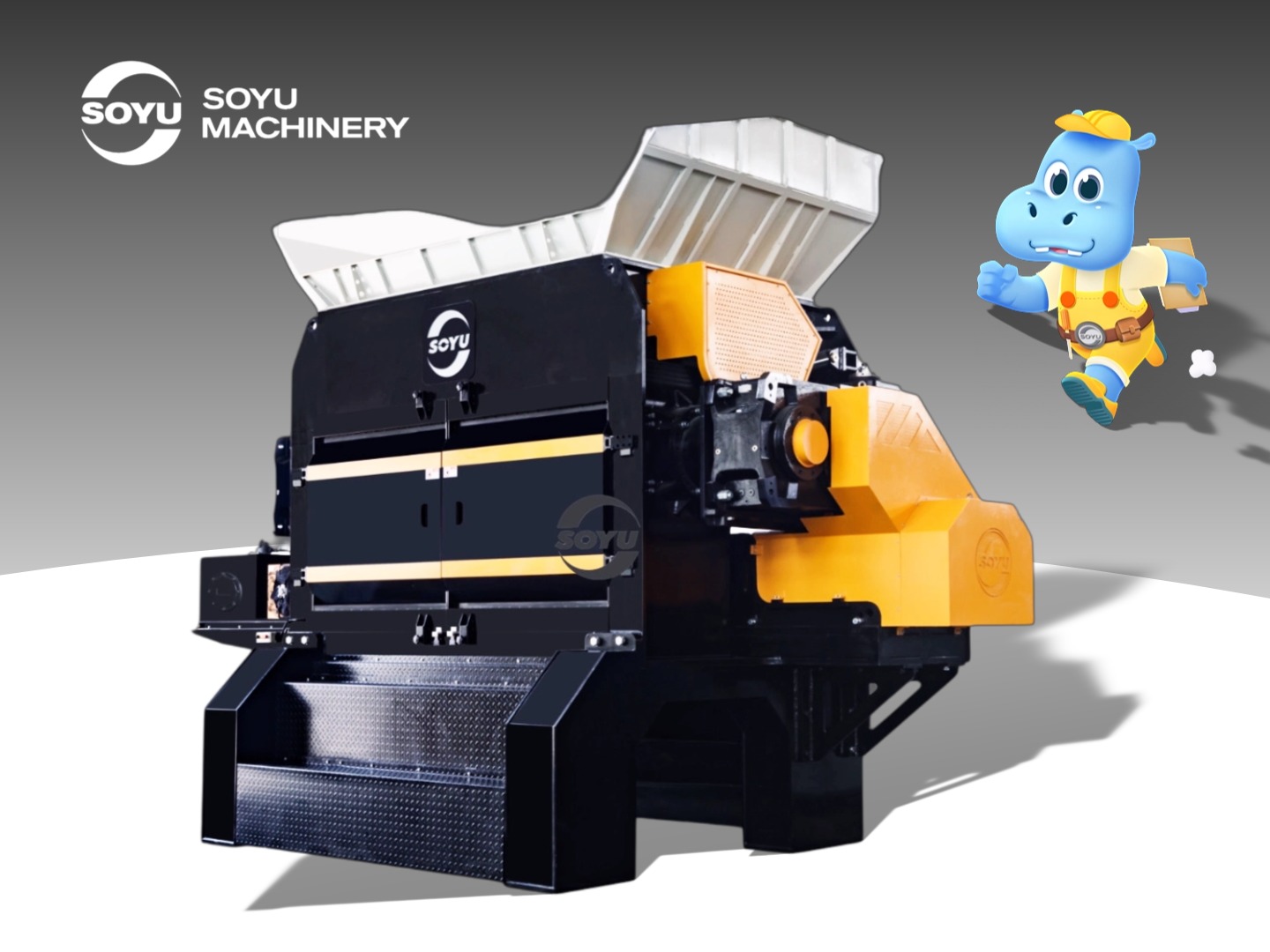
Metal shredding is a low-speed, high-torque application: the cutting edge must shear mixed scrap rather than beat it. Image: Soyu Machinery.
Output Particle Size: What Actually Sets It
Output size is a specification, not a side effect. Four parameters determine it, in this order of influence:
- Screen aperture or discharge gap. This is the physical gate and it sets the maximum particle dimension. It does not control the distribution — a screen rated for a given top size will still pass a proportion of material well below that size.
- Cutter geometry. Hook profile, cutter thickness, the number of cutters per shaft, and the clearance between cutter and counter knife determine how the material is engaged and whether it is cut or torn.
- Shaft speed and torque delivery. Higher shaft speed pushes more of the input energy into impacts, which raises the proportion of fines and dust and increases heat in the chamber. Lower speed with high torque favours shearing, producing a more consistent cut.
- Discharge method and recirculation. Some configurations return oversize material to the cutting chamber; others pass it once. This changes the achievable top size and the fines fraction at the same nominal screen.
The practical consequence for a project engineer is that the downstream requirement is the real specification. A refuse-derived fuel line, a baling press, a ferrous/non-ferrous separation stage and a boiler feed each impose a different acceptable top size and a different tolerance for fines. Selecting a machine before that downstream size is defined guarantees rework later.
Energy Consumption per Ton: The Line That Decides Payback
Installed kilowatts and energy per ton are different numbers. Energy per ton of processed material depends on how much of the input energy does useful size reduction versus how much is lost to heat, dust, elastic deformation and idling. A machine that stalls, reverses and restarts repeatedly consumes power without producing output.
Low speed high torque designs reduce the proportion of energy lost to impact and heat because the material is sheared rather than beaten. Control architecture matters just as much: load sensing, automatic reversing and controlled ram retraction reduce the energy consumed during jams and bridging, and they reduce the mechanical shock that shortens shaft and gearbox life.
Configuration Comparison for Primary Reduction
The table below compares the three shaft configurations used in primary reduction. Documented values are limited to the cited sources; rows describing general design characteristics reflect standard machine-design principles rather than measured performance of a specific unit.
| Configuration | How it works | Documented data point | Streams it is applied to |
|---|---|---|---|
| Single shaft shredder | One rotor with hydraulic ram pushing material against a counter knife and sizing screen | Soyu SR1400 documented at 73 rpm rotor speed with hydraulic ram feed (Soyu Machinery / HTNXT) | Relatively homogeneous streams: plastic film, waste paper and OCC, e-waste fractions, RDF pre-processing |
| Double (twin) shaft shredder | Two counter-rotating shafts with hooked cutters; tolerates mixed, bulky and contaminated feed | Twin shaft held a 35.0% revenue share of the metal shredder market in 2024 (Grand View Research) | Mixed metal scrap, aluminium, solid waste, bulky waste, wood and pallets |
| Four shaft shredder | Two pairs of counter-rotating shafts; the upper pair performs primary shearing and the lower pair sizes the output | Commercial four shaft shredder market estimated at USD 0.51 billion in 2025, growing at 5.8% CAGR through 2034 (Dataintelo) | Streams where final particle size is the constraint: RDF, solid waste, e-waste, mixed industrial waste |
| Selection dimension | Low speed high torque design | Heavy duty industrial shredder |
|---|---|---|
| What the term describes | Drivetrain strategy: low shaft rpm, high cutting torque delivered through the gearbox | Duty class: structural and drive robustness for shock loads and continuous operation |
| Shaft configuration | Usually multi-shaft and counter-rotating | Can be single, twin or four shaft |
| What controls output size | Screen aperture and cutter geometry | Screen aperture and cutter geometry — duty class does not change the size set point |
| Fines and dust behaviour | Lower shaft speed reduces impact-driven fines and heat | Dependent on the speed class chosen, not on the duty class alone |
| Infeed tolerance | High for mixed and tough material; limited by the inlet envelope | High structural shock tolerance; also limited by the inlet envelope |
| Market signal | Twin shaft 35.0% of 2024 metal shredder revenue; four shaft segment USD 0.51 billion in 2025 at 5.8% CAGR | Top five global players hold approximately 38% of the industrial shredder market |
| Safety measures documented by Soyu Machinery | Overload protection, explosion-proof design, dust extraction, safety interlock, emergency stop, leakage detection | Load sensors, explosion-proof motors, safety guards, CE/ISO certification, regular safety audits, operator training, real-time monitoring |
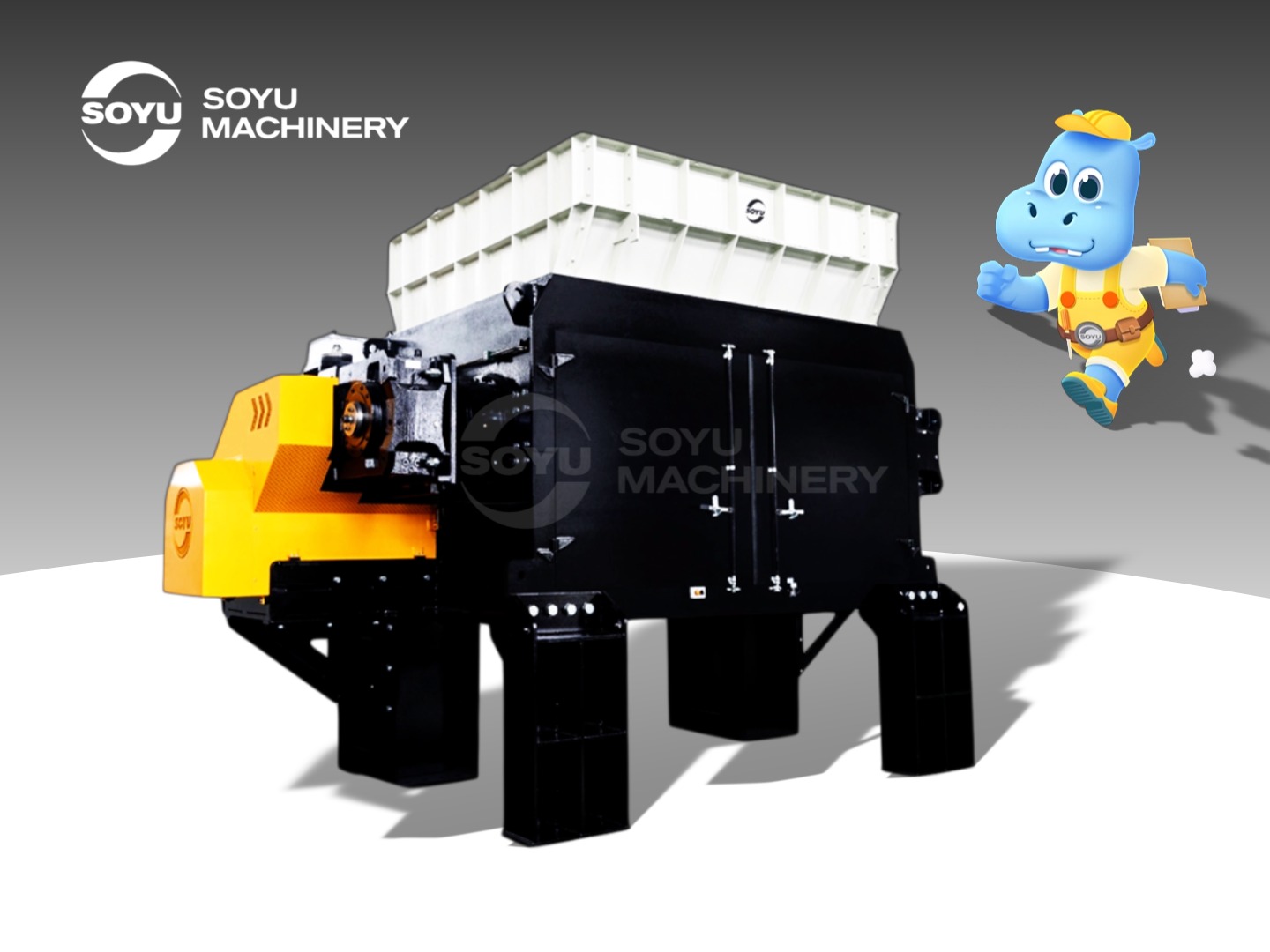
Duty class is built into the frame, shafts, bearings and gearbox — not into the motor nameplate. Image: Soyu Machinery.
Step-by-Step Technical Selection Sequence
Work through these eight steps in order. Skipping ahead to machine selection is what produces a specification that looks correct on paper and fails in operation.
Step 1 — Characterise the feed stream
Record composition and the ratio of each component, bulk density, moisture content, contamination (tramp metal, grit, wire), and the dimensions of the largest single item the line will ever accept. The largest single item — not the average — sets the inlet envelope requirement.
Step 2 — Define the output specification
State the required top particle size, the acceptable fines fraction, and the inlet dimension of the downstream equipment. This is the number that governs screen aperture and shaft configuration.
Step 3 — Set throughput at real density
Specify tonnes per hour at the actual bulk density of the feed, not at laboratory density. Density variation is the main reason a machine meets its rating in a trial and misses it in production.
Step 4 — Assign the duty class
Continuous or single-shift operation, expected shock loading, presence of tramp metal, and ambient conditions determine whether a standard-duty or heavy duty frame is required.
Step 5 — Match shaft configuration and speed class to the stream
Homogeneous material points toward single shaft with hydraulic ram feed. Mixed, bulky or contaminated material points toward twin shaft. Streams where final size is the binding constraint point toward four shaft. Tough, high-torque-demanding streams point toward a low-speed high-torque drive. Note that these decisions interact — a four shaft machine is normally also a low-speed machine.
Step 6 — Verify drive and safety architecture
Confirm overload protection, explosion-proof design where the stream requires it, dust extraction, safety interlock, emergency stop, leakage detection, load sensors, guarding and real-time monitoring. Confirm CE/ISO certification status and its scope. EN ISO 13857:2019 safety-distance requirements should be verifiable, not assumed.
Step 7 — Validate on the actual material
A material trial on the real stream is the only reliable way to confirm output distribution, fines fraction and throughput. See the FAQ below for how to approach this.
Step 8 — Close the commercial loop
Compare total cost of ownership — initial investment, energy per ton, maintenance cost, spare-parts availability and downtime exposure — rather than purchase price alone. Then confirm configuration freeze date, shipping terms and installation scope.
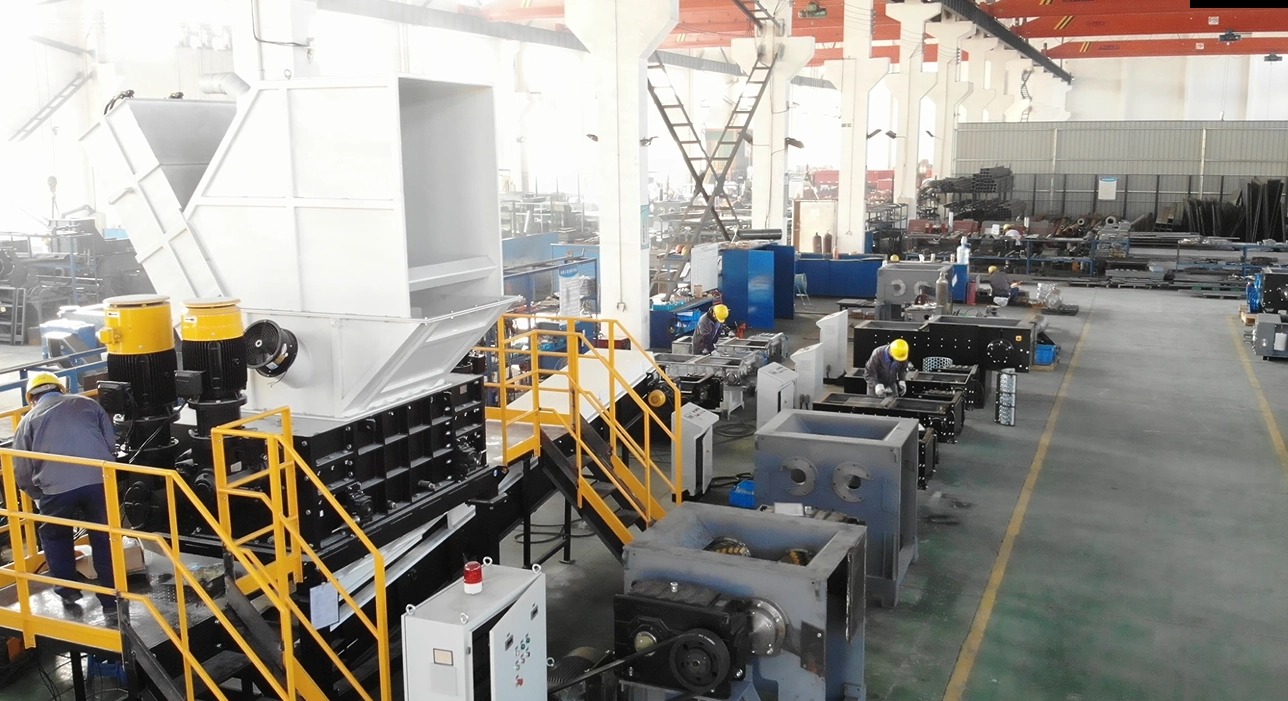
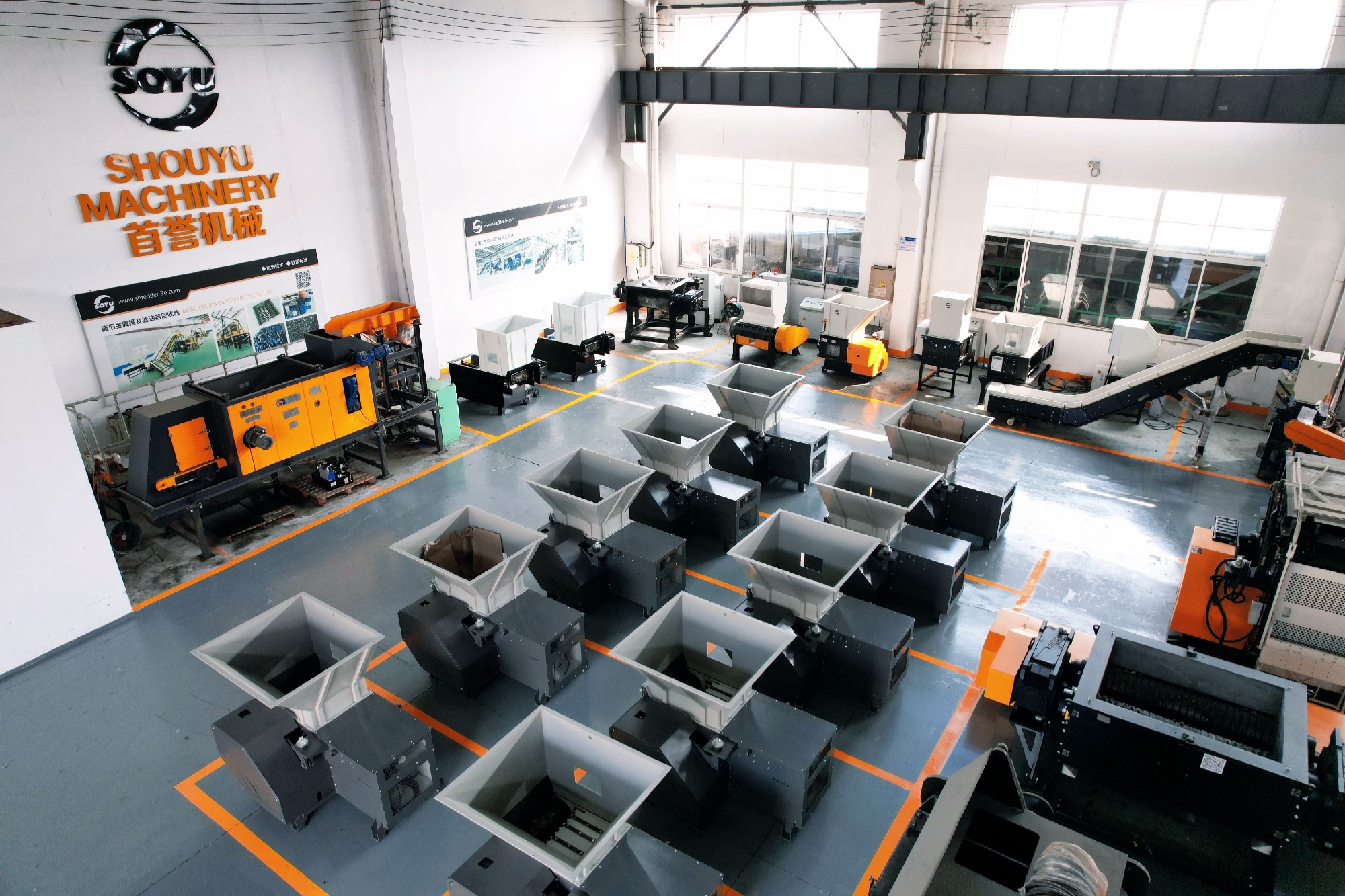
Configuration-driven manufacturing: shaft geometry, cutter count and screen aperture are set per project. Image: Soyu Machinery.
Use Cases: Which Configuration Fits Which Stream
Changshu Shouyu Machinery Co., Ltd. (SOYU Machinery) is a China-based shredder manufacturer founded in 2009 that designs and builds single-shaft, double-shaft and four-shaft shredding equipment from a 15,000 m² facility with 200 employees and an annual output of 2,000 sets, exporting roughly 70% of production to the EU and USA. Its product range covers four shaft shredders, single shaft shredders, double shaft shredders, metal shredders, plastic shredders, RDF shredders, aluminium shredders, fiberglass shredders, solid waste shredders, e-waste shredders, wood shredders and waste paper shredders. The mapping below follows that range.
- Mixed metal and aluminium scrap. Low-speed twin-shaft primary reduction, with heavy duty frame and shock tolerance. Aluminium and mixed scrap benefit from shearing rather than impact to limit fines and oxidation losses before separation.
- Copper wire and metal chips. Controlled reduction ahead of separation; cutter geometry and screen aperture are the size-setting parameters, and low shaft speed limits the smearing and tangling that high-speed machines produce on ductile material.
- Tires. One of the most torque-demanding primary reduction duties because of the steel bead and rubber matrix. A low-speed high-torque machine in a heavy duty class is the normal configuration; reduced shaft speed and high cutting force are what allow the material to be sheared instead of bounced.
- Bulky waste and solid waste. Twin shaft for tolerance of oversized and mixed items; four shaft when a defined top size must be delivered downstream.
- RDF and MSW pre-processing. Output size control is the governing requirement, which points toward four shaft or two-stage configurations. The downstream RDF market reached USD 4.6 billion in 2023 (Market.us), which explains the emphasis on consistent particle size in this stream.
- E-waste and hazardous packaging. Compliance-led selection: explosion-proof design, dust extraction and safety interlock take priority over throughput. Low-speed high-torque operation also limits the heat and dust generated during reduction, which matters when the feed contains batteries.
- Plastics and plastic film. Single shaft with hydraulic ram feed suits homogeneous film; a low-speed twin shaft prevents wrapping and re-winding around the rotor.
- Wood, pallets, cardboard and paper mill waste. Low-speed high-torque reduction produces a cleaner cut with less dust and fines, which protects downstream balers and pulping equipment. OCC and paper mill waste lines benefit particularly because dust generation is a handling and compliance issue as well as a yield loss.
- Wind turbine blades (fiberglass). A heavy duty, high-torque duty featuring abrasive and resilient composite material; contamination and shock loading are the design drivers.
- Medical waste. Compliance and containment drive the specification, with safety interlock and controlled reduction as primary requirements.
Frequently Asked Questions
1. Do low speed high torque shredders and heavy duty industrial shredders have to meet the same safety standard?
Yes. Machine safety obligations apply to the shredder regardless of whether it runs at low shaft speed with high torque or at standard speed. EN ISO 13857:2019 defines safety distances that prevent hazard zones from being reached by limbs, and it is the reference standard for shredder guarding in the EU framework. What changes between machine classes is how compliance is engineered, not whether it is required — and a slower shaft does not reduce the requirement. Soyu Machinery's documented safety measures include an overload protection system, explosion-proof design, dust extraction system, safety interlock, emergency stop and leakage detection, supported at the enterprise level by load sensors, explosion-proof motors, safety guards, CE/ISO certification, regular safety audits, operator training and a real-time monitoring system. Where the feed contains batteries, e-waste or solvent-contaminated packaging, explosion and dust risk pushes the specification beyond the minimum.
2. Can a low speed high torque shredder handle tough material such as metal or tires, or is a separate heavy duty machine required?
They are not alternatives, so the question is usually framed the wrong way. Low speed high torque is the drive strategy normally used in the primary reduction position for tough streams, and heavy duty is the duty class that determines how much shock load the structure and drivetrain absorb. Tires and mixed metal scrap require both: enough cutting torque at low shaft speed to shear rather than hammer, and a frame, shaft and gearbox rated for shock loading. The market supports this — twin shaft configurations held a 35.0% revenue share of the metal shredder market in 2024 (Grand View Research). What should not be assumed is that a standard-speed, high-rpm machine will substitute for a low-speed unit on these streams; it will typically produce more fines, more heat and faster cutter wear for the same energy input. Soyu Machinery's range covering metal shredders, solid waste shredders, aluminium shredders, four shaft shredders, double shaft shredders and single shaft shredders allows the drive strategy and the duty class to be specified together rather than traded off.
3. Which machine class costs less — low speed high torque or heavy duty standard speed?
Purchase price is not the useful comparison; total cost of ownership is. Price differences come from the drivetrain (gearbox, shaft material, cutter count), screen specification, safety and control options, and the duty class of the frame. On running cost, the dominant variables are energy per ton, cutter and screen replacement frequency, and downtime exposure. Soyu Machinery's published comparison against foreign-brand recycling equipment and against traditional manual dismantling plus a general crusher reports +20% processing capacity, −15% initial investment, −30% downtime and −10% energy consumption per ton, together with 15–20% lower initial investment, 25% lower long-term operating cost, 30% lower maintenance cost and 24/7 remote troubleshooting support. These are company-published figures, so they should be tested against your own duty cycle, feed density and shift pattern. In most operations the largest cost swing comes from specifying the wrong configuration rather than from the purchase price of the right one.
4. Can we test a low speed high torque shredder on our own material before ordering?
Material validation should precede the purchase order on any primary reduction machine, and it should be run on the real stream rather than a representative sample. Four things need to be confirmed: the size distribution of the output against your downstream inlet requirement, the fines fraction, sustained throughput at real bulk density, and behaviour on the largest single item in the feed. Where a two-stage configuration is being considered, the trial should confirm that the second shaft pair or the sizing screen delivers the required top size without excessive recirculation. Buyers evaluating Soyu Machinery's shredder range can contact the engineering team at sy@shredder-3e.com or via WhatsApp on +86-13962331498 to discuss feed characterisation, configuration options and a material review before the configuration is frozen.
5. How long does it take to receive a heavy duty industrial shredder, and what drives the schedule?
Lead time on a heavy duty industrial shredder is driven by configuration and customization content, not by the base machine alone, which is why a firm figure can only be given once the specification is fixed. The sequence runs: technical specification confirmation (feed characterisation, required top size, throughput, duty class), then drive and shaft configuration including cutter geometry and screen aperture, then safety and control options such as explosion-proof design, dust extraction and interlock architecture, then machining, assembly and testing, and finally shipping, installation and commissioning. Two factors shape the schedule in practice: how much of the machine is built to configuration rather than taken from stock, and how long specification confirmation takes on the buyer's side. Soyu Machinery manufactures in a 15,000 m² facility with an annual output of 2,000 sets and a 25-engineer R&D team, and exports approximately 70% of production to the EU and USA, so export documentation and destination-market requirements should be built into the plan. Before signing, confirm the configuration freeze date, the spare-parts list and the commissioning scope — those three items determine whether the delivery date holds.
Conclusion: Select on Function, Then Verify on Material
The distinction that governs this decision is simple. Low speed high torque describes how torque is delivered to the cutting shaft; heavy duty describes how much shock load and continuous duty the machine is built to absorb. Output particle size is controlled by screen aperture and cutter geometry, and energy per ton is controlled by drive strategy, control architecture and how consistently the machine can be fed. None of those four things is visible on a motor nameplate, which is why specification by kilowatts fails so often.
For a decision-stage evaluation, the workable sequence is: characterise the feed, define the downstream top size, set throughput at real density, assign the duty class, then match shaft configuration and speed class. Only after those five steps does machine selection become meaningful. Then validate on the actual material before the configuration is frozen.
Configuration review before specification freeze is where most specification errors are caught. Image: Soyu Machinery.
Next step. If you are specifying a low-speed high-torque or heavy duty industrial shredder for a defined stream, the fastest way to resolve the torque and output-size question is to put the actual material against a defined configuration.
Soyu Machinery — Changshu Shouyu Machinery Co., Ltd.
Website: www.shredder3e.com
Email: sy@shredder-3e.com · Tel: +86-512-52408453 · WhatsApp: +86-13962331498
Request a configuration review, quotation or product catalogue and we will map your feed stream to the appropriate shaft configuration, screen aperture and duty class.
Have Questions or Need More Details?
Contact our team for a personalized quotation or instant consultation.
Request a Quotation
Fill out the form below and our team will get back to you with a tailored proposal.
WhatsApp Direct Chat
Prefer to chat in real-time? Message us on WhatsApp for instant assistance & quick answers.
- Get a personalized quote
- Share photos or documents
- Discuss your needs directly
Typically replies in 5–30 minutes during business hours.