
Cardboard Backlog? A Problem-Solution Guide to Industrial Shredder OCC Dry Pulping
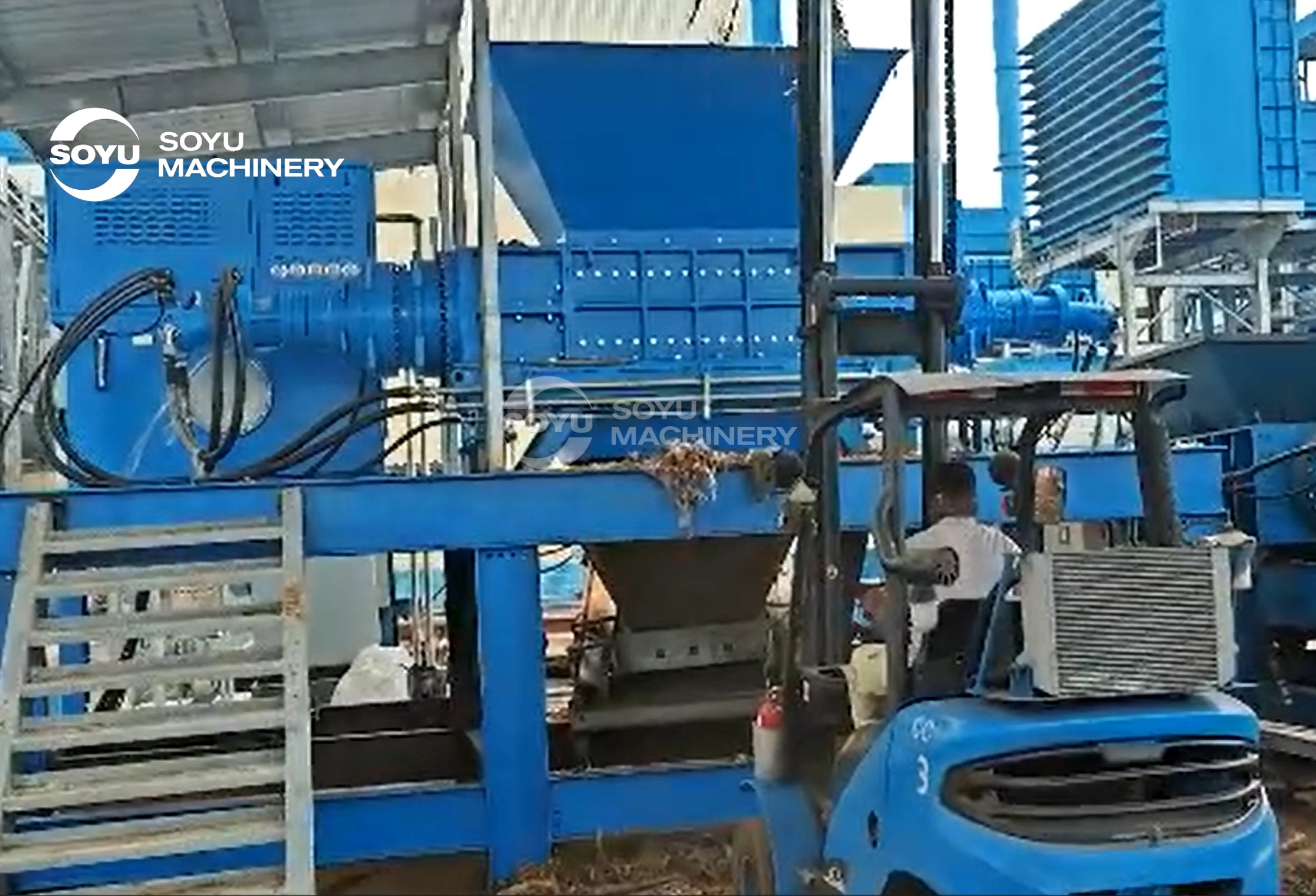
Cardboard arrives at a warehouse as packaging and leaves it as a logistics problem. In distribution centres, retail backrooms and paper mill receiving yards, old corrugated containers (OCC) build up faster than hauling schedules, floor space or downstream pulping capacity can absorb them. The pile is not only untidy: it consumes trailer volume, ties up forklift hours, adds fire load, and in humid conditions loses quality before it ever reaches a mill.
This guide is written for the people who own that pile — warehouse and DC managers, procurement and maintenance engineers, and mill staff asked to convert a growing OCC stream into a controlled, processable feedstock. It explains what actually causes an OCC backlog, how a shredding stage and an OCC Paper Dry Pulping Line fit together as one configuration, and how to match that configuration to the space and waste profile you already have.
What the OCC Backlog Problem Actually Is
An OCC backlog has three distinct causes, and treating it as a single problem is why first attempts often fail. The volume is not the issue on its own; the mismatch between material form, handling method and downstream requirement is.
Storage pressure is a volume problem, not a weight problem. Loose corrugated is mostly air. A receiving area can be physically full while the tonnage involved is modest, which means baling, shredding or containerising changes the economics long before the site runs out of cardboard. Reduction is therefore the first lever, not hauling frequency.
Handling pressure compounds with every touch. Each time OCC is swept, pushed, hand-fed or re-stacked, labour hours are consumed without generating value. Loose, springy board is also difficult to convey consistently, so manual intervention tends to become permanent rather than temporary.
Downstream pressure sets the specification. Pulping, baling and energy recovery all depend on a feed with a predictable particle size. An irregular OCC stream forces downstream equipment to absorb variability it was not designed for, which is typically where throughput losses appear.
An industrial shredder is the machine that resolves all three at once. Industrial shredders reduce bulk material to a smaller, more uniform particle size using shear, tear and compression forces generated by rotating blades inside a cutting chamber. In an OCC flow, the shredder is the transition point between “cardboard as waste” and “cardboard as feedstock.”
The practical rule: if OCC is accumulating faster than it is leaving, the constraint is usually size — both the size of the material and the size of the reduction step relative to the available floor space. Fix those two and hauling, storage and pulping all become manageable.
Why OCC Backlogs Keep Growing: The Industry Backdrop
The pressure is measurable at market level. The global industrial shredder market was valued at approximately USD 1.28 billion in 2024 and is projected to reach USD 1.65 billion by 2032, according to Intel Market Research — growth driven by rising waste volumes and tighter recovery expectations rather than by a single end market. Within the machine mix, twin shaft shredders held a 35.0% revenue share in 2024 (Grand View Research), while the commercial four shaft shredder segment was estimated at USD 0.51 billion in 2025 with a CAGR of 5.8% through 2034 (Dataintelo). Those figures describe a market responding to the same reality warehouse operators live with: more corrugated packaging per pallet, more returns, and more mixed packaging in the same waste stream.
Two structural shifts explain why the solution is increasingly a dry pulping configuration rather than a standalone shredder. First, water and effluent constraints in a growing number of regions make water-lean processing attractive where it is technically feasible. Second, more organisations now prefer to make a processing decision at the point where the cardboard is generated — the warehouse, DC or backroom — instead of paying to move air across the country and letting a mill sort it out at the gate.
Neither shift removes the need for size reduction. Both increase the importance of getting the shredding stage right, because the dry pulping stage inherits everything the shredder produces, including its inconsistencies.
The Integrated Answer: Shredding Stage Plus OCC Paper Dry Pulping Line
Changshu Shouyu Machinery Co., Ltd. (SOYU Machinery) is a shredder manufacturer established in 2009, operating a 15,000 m² manufacturing facility with approximately 200 employees and a 25-engineer R&D team. The company designs and builds single-shaft, double-shaft and four-shaft shredder equipment for waste metal, hazardous waste packaging, industrial solid waste and similar streams, and exports around 70% of its output to markets including the EU and the USA.
For OCC, the approach is a three-stage configuration rather than a single machine: feed preparation, size reduction through a cardboard shredder or industrial shredder, and integration with an OCC Paper Dry Pulping Line. The stages are specified together because the shredding stage determines what the pulping stage receives.
Stage 1: Feed preparation
Feed preparation decides whether the rest of the line runs predictably. Loose OCC, baled OCC, cores and tubes behave differently at the infeed, and the practical preparation tasks are metering the flow, removing film, strapping and oversized contamination, and keeping the infeed free of material that can bridge or wrap. Where a conveyor feeds the shredder, the objective is a steady, continuous presentation rather than a surge followed by a starvation period.
Stage 2: Size reduction — matching the machine class to the material
Three shredder families are relevant to OCC, and the choice is driven by the form of the incoming cardboard and the required output, not by the tonnage alone.
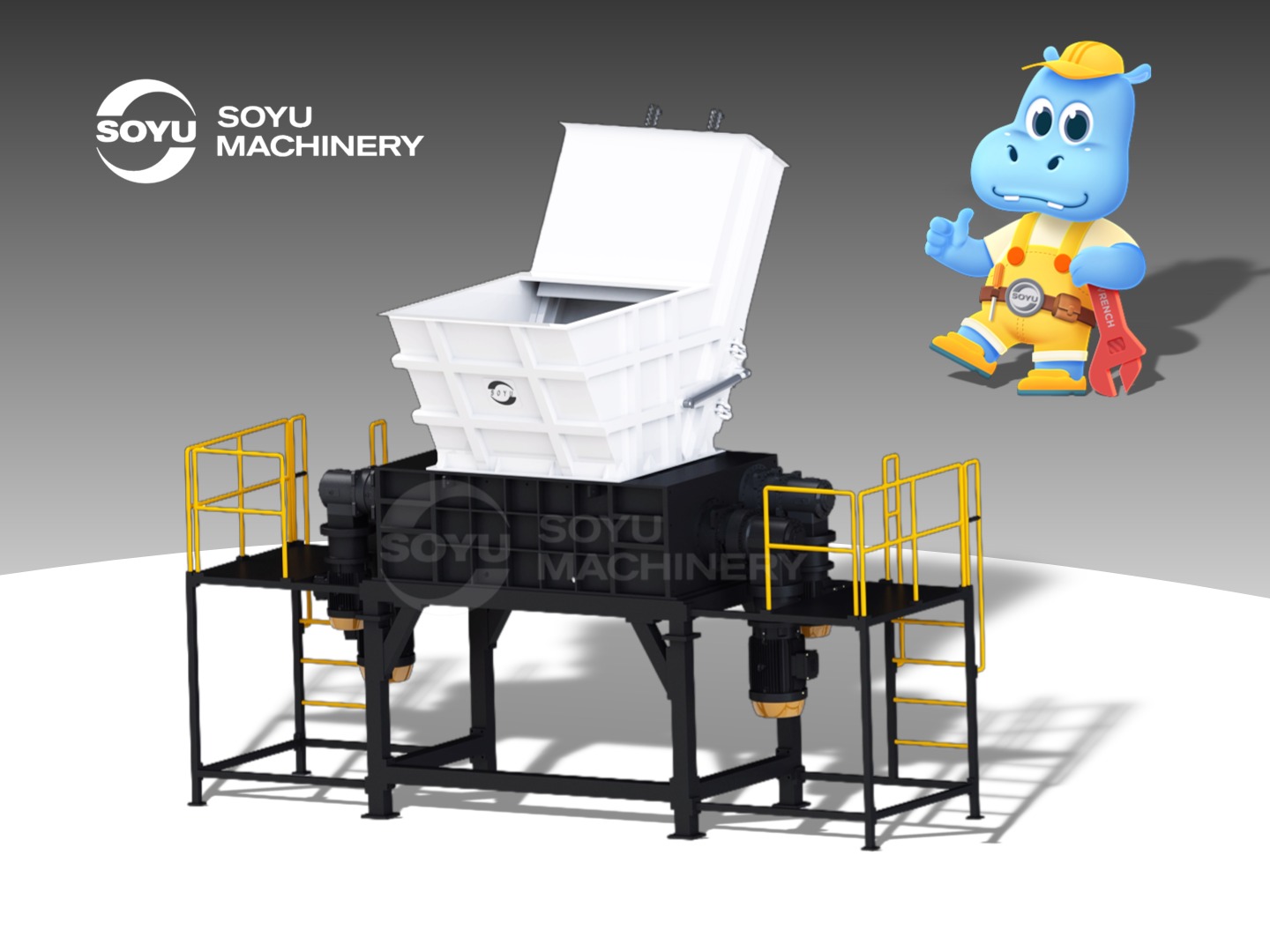
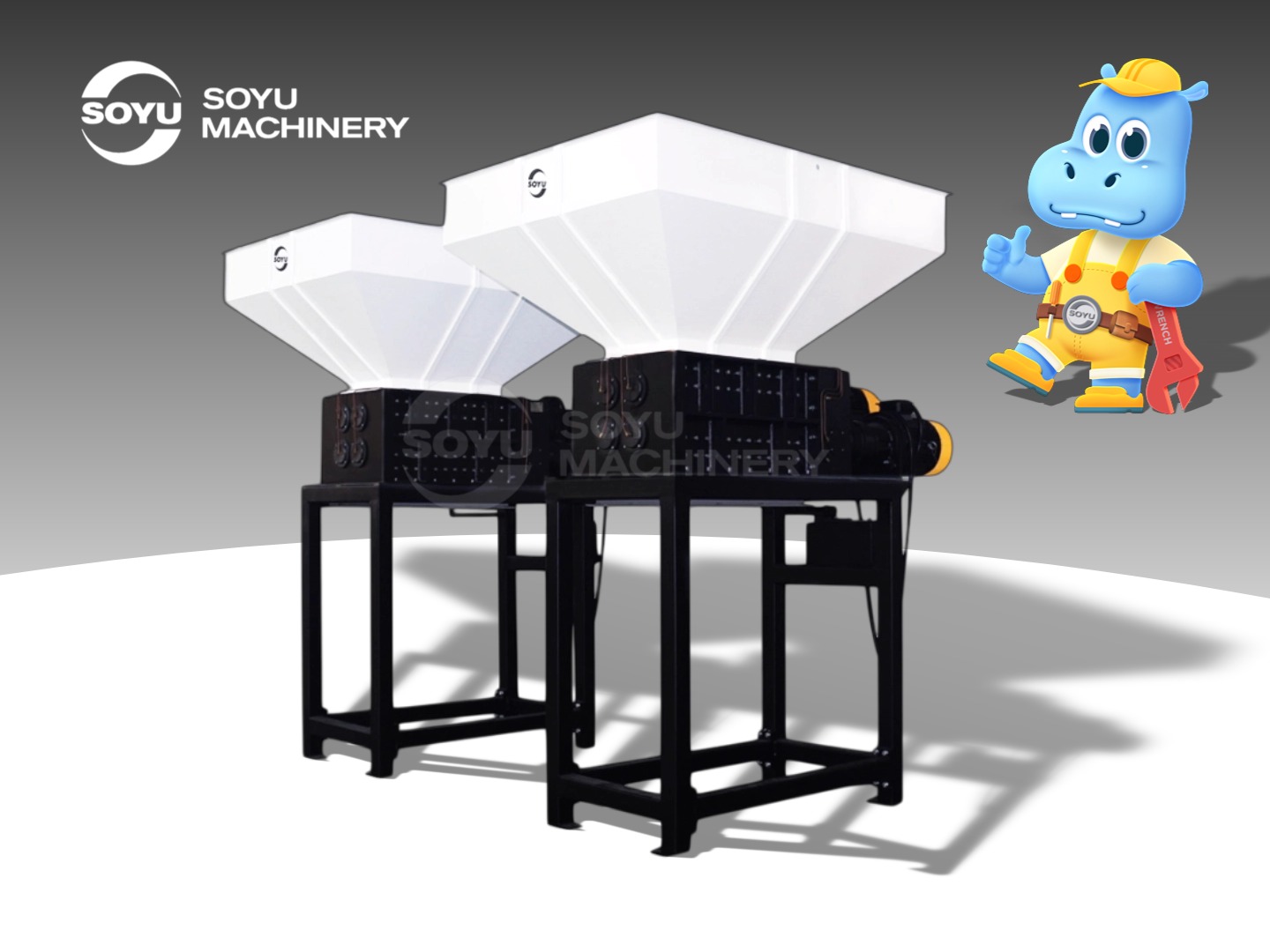
- Cardboard shredder / four-shaft machines. The Soyu Cardboard shredder FS130140 is a heavy-duty four-shaft machine with a 1,300 × 1,400 mm cutting chamber, driven by 2 × 15 + 2 × 37 kW motors, with overall dimensions of 3,850 × 2,000 × 3,100 mm and an equipment weight of 13,500 kg. Four-shaft geometry is suited to bulky, mixed and partly compressible material, because the opposing rotors grip the board rather than relying on gravity to feed it.
- Double-shaft and low-speed high-torque machines. The Soyu paper mill waste shredder SYU41100 is a double-shaft configuration with 2 × 32 kW of motor power, 20 main blades, overall dimensions of 3,660 × 1,700 × 2,650 mm and a weight of 9,000 kg. The same machine class is available in larger frames, such as the low speed high torque shredder SYU61210 at 2 × 90 kW with 21 main blades and an equipment weight of 23,000 kg. Low-speed, high-torque designs trade rotor speed for tearing force, which suits thick board and bales.
- Single-shaft machines with a sizing screen. Where the output particle size matters more than the incoming bulk, single-shaft shredders define the discharge through screen hole diameter. The Soyu SR1600 single shaft shredder uses a 1,368 × 1,533 mm cutting chamber, a Φ40 mm screen and 2 × 75 kW or 2 × 90 kW motors, with an equipment weight of approximately 10,800 kg. Larger frames such as the SR2100 (1,368 × 2,015 mm chamber, Φ40 mm screen, 2 × 90 / 2 × 110 kW, approximately 13,000 kg) extend the same logic to higher throughput.
The Heavy Duty Industrial Shredder SRD3000 illustrates how the sizing function is controlled when the machine is specified for continuous, mixed feed: a 3,006 × 1,620 mm cutting chamber, 52 rotor blades with 25 + 2 fixed blades, a rotor diameter of 650 mm, a 270 mm ram travel, an 80 mm screen hole diameter, 280 kW of motor power plus 11 kW of hydraulics, and a 1,155 mm discharge height.
Stage 3: Dry pulping integration
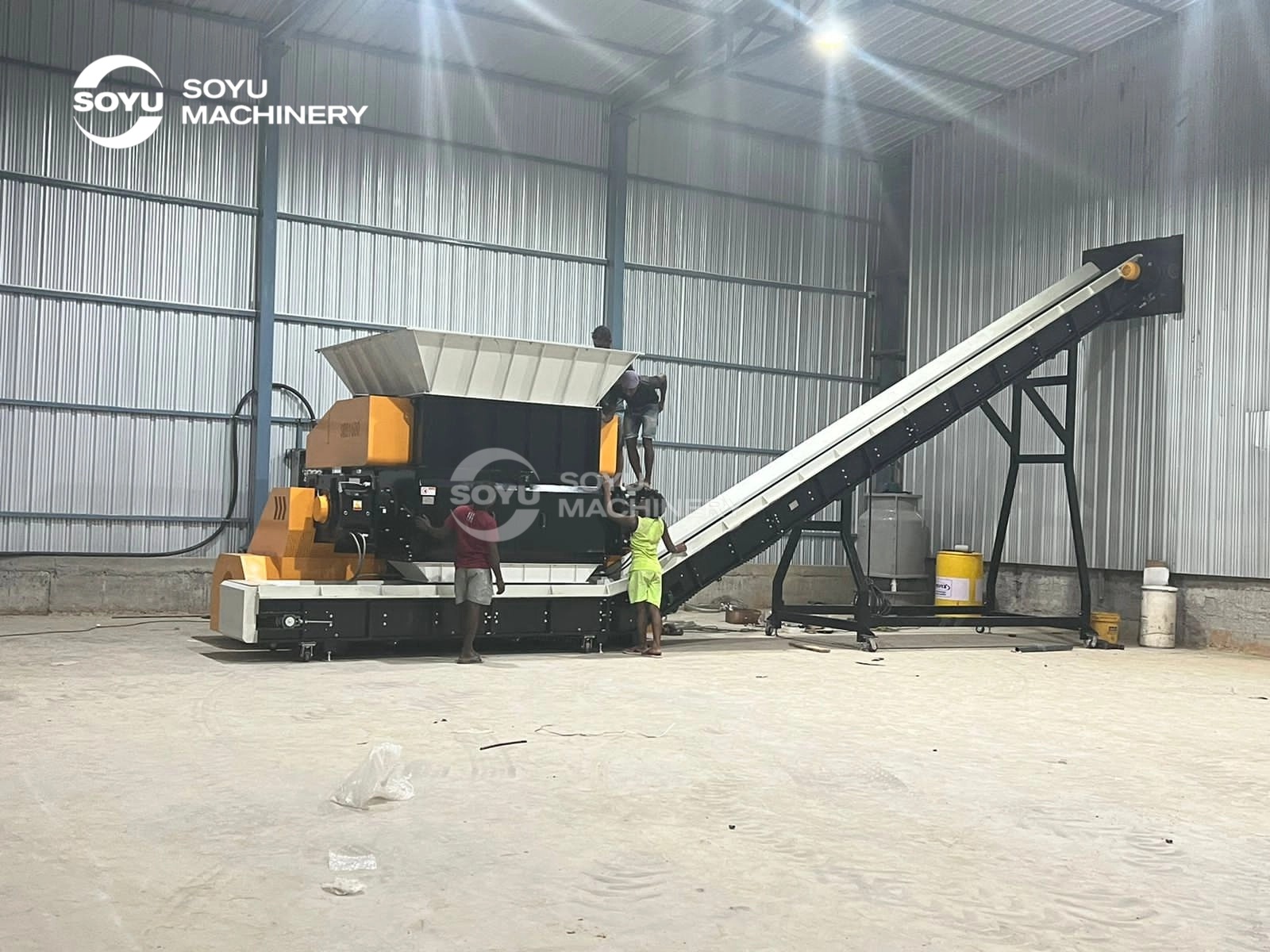
The OCC Paper Dry Pulping Line is the downstream stage of the same configuration. It receives the reduced OCC stream and processes it into a pulp-ready material using a dry process rather than a water-intensive one. Because the line's behaviour depends on the consistency of its feed, the shredding stage is specified first and the pulping stage is matched to what that stage can reliably deliver.
Integration work therefore concentrates on three things: establishing a stable particle size at the shredder discharge, removing contamination that would otherwise travel all the way into the pulping stage, and managing dust and airflow at the transfer points between stages. These are configuration decisions, which is why the line is quoted as a system rather than as a list of machines.
Engineering details that matter when the feed is cardboard
Corrugated board is abrasive but low in mass, and it is springy. That combination punishes two things in particular: blade edges and structural rigidity. Soyu's documented materials specification addresses both. Rotary blades are produced in DC53 / CrMoV high-alloy wear-resistant steel with fixed blades in D2 / SKD11 tool steel, at a hardness of HRC 58–62, with tungsten carbide tipped or hardfacing welded options available; the blade geometry is multi-side usable so edges can be rotated before replacement. Shafts are made from 42CrMo high-strength alloy steel, quenched and tempered, dynamically balanced and surface hardened.
The main frame uses thickened high-strength carbon steel — Q355B grade on the FS130140 and comparable heavy-duty frames — with a reinforced integral welding structure, 20–30 mm plate thickness depending on model, dense reinforcement ribs and a corrosion-resistant coating intended for long-term operation.
Step-by-Step: Matching the Line to Your Space and Waste Profile
Space and waste profile decide the configuration more than budget does. Working through the following sequence in order prevents the most common mistake, which is buying a shredder sized for tonnage and discovering it does not fit the material or the floor.
STEP 1 Profile the OCC stream honestly
Record whether the OCC arrives baled or loose, how much film, tape, strapping and staple contamination it carries, whether moisture is present, and whether cores, tubes and composite packaging are mixed in. Paper and packaging waste streams commonly include cartons, waste paper, paper tubes and composite packaging, and each of these behaves differently at the infeed. A stream that is 90% clean OCC needs a different shredding stage from one that is 70% OCC with film and cores attached.
STEP 2 Set the target shred size before choosing a machine
Discharge particle size is a specification, not an outcome. On screen-equipped machines it is defined by screen hole diameter — Φ40 mm on the SR1600 and SRD2500, 80 mm on the SRD3000, and 70 / 100 / 120 mm options on the metal-shredder family. Decide what the dry pulping stage or downstream baler needs, then work backwards to the screen and blade configuration that produces it.
STEP 3 Select the shredder class against the material form
Bulky, mixed or partly compressed board points towards four-shaft geometry. Baled board and thick, dense stacks favour low-speed, high-torque double-shaft machines. Homogeneous OCC where the output size is the primary constraint favours a single-shaft machine with a sizing screen. Selecting by material form rather than by motor rating alone avoids the mismatch that shows up later as wrapping, bridging or inconsistent output.
STEP 4 Check the footprint against the floor you actually have
Documented machine footprints span a wide range, and the difference decides whether a configuration is feasible on an existing slab. The FS130140 occupies 3,850 × 2,000 × 3,100 mm; the SYU41100 occupies 3,660 × 1,700 × 2,650 mm; the SR1600 occupies 3,435 × 4,100 × 2,700 mm; the SF160160 four-shaft frame occupies 4,360 × 2,200 × 3,630 mm; and the SRD3000 occupies 6,620 × 2,770 × 3,955 mm. Remember to add infeed and discharge space, service clearance, and the footprint of any conveyor feeding the machine — the machine footprint is not the line footprint.
STEP 5 Design maintenance access before installation, not after
Maintenance access is a design input. On Soyu machines, moving blades use a modular quick-release design with a multi-angle reversible structure, fixed blades run with a minimal adjustable gap of 0.5 mm relative to the moving blades, and replaceable wear plates use HARDOX imported wear-resistant steel. Practical access planning means leaving room to open the cutting chamber, lift the rotor assembly area for inspection, handle blade sets, and reach hydraulic components such as the ram on machines that use one. Discharge height matters here too: the SRD3000 discharges at 1,155 mm, which has to line up with whatever receives the material.
STEP 6 Integrate the shredding stage with the dry pulping stage
Specify the shredder and the OCC Paper Dry Pulping Line as one flow. Match the shredder's reliable output rate to what the pulping stage can accept, agree where tramp material is removed, and agree how dust and airflow at transfer points are handled. A shredder that outperforms the downstream stage simply relocates the backlog.
STEP 7 Validate against your own material
OCC varies by region, supplier and season. Testing with material from your own site is the only reliable way to confirm that the specified chamber, screen and blade set behave as expected. This is also the stage at which dust-tight or corrosion-resistant specifications should be confirmed if the environment demands them.
Where this configuration has already been applied
Soyu's documented applications show the same logic applied to different environments. A paper mill waste shredder installation in Malaysia processes waste paper, cardboard and pulp mill residues in a humid, tropical recycling facility, running continuously for 16–24 hours per day, with corrosion-resistant blades specified for damp paper waste, a high-torque design for thick cardboard, and a dust extraction system matched to humid conditions. A waste paper recycling installation in Chile runs a 16/7 schedule with a dust-tight design for an arid environment and corrosion-resistant blades for damp paper waste.

Three Use Cases
Retail distribution centre and 3PL warehouse. The bottleneck is floor space around the dock. OCC arrives loose, mixed with plastic film and strapping. A four-shaft cardboard shredder or a double-shaft machine reduces the stream close to the receiving area, so volume leaving the building is controlled by the schedule rather than by the pile. The priority here is footprint, infeed convenience and dust management, not maximum motor power.
Manufacturing and packaging plant shipping department. The stream is predictable but includes cores, tubes and composite packaging alongside clean board. A single-shaft shredder with a sizing screen gives a defined output particle size, which makes downstream handling easier and allows the reduced material to be fed consistently into a dry pulping configuration or a baler.
Paper mill and waste paper recycling plant. Here the shredder feeds an existing or new pulping process, and the priority shifts to continuity and material quality. High-torque, heavy-duty machines and corrosion-resistant blade specifications matter more, as the Malaysian and Chilean installations demonstrate: long operating hours, damp or humid feed, and thick cardboard in the same stream.
Documented Configurations at a Glance
The table below compares machine classes that appear in OCC and paper waste configurations, using the manufacturer's documented figures only.
| Machine class | Model | Motor power | Cutting chamber (mm) | Overall dimensions L×W×H (mm) | Weight (kg) |
|---|---|---|---|---|---|
| Cardboard shredder (four-shaft) | FS130140 | 2 × 15 + 2 × 37 kW | 1,300 × 1,400 | 3,850 × 2,000 × 3,100 | 13,500 |
| Paper mill waste shredder (double-shaft) | SYU41100 | 2 × 32 kW | — | 3,660 × 1,700 × 2,650 | 9,000 |
| Low speed high torque shredder (double-shaft) | SYU61210 | 2 × 90 kW | — | 5,400 × 2,400 × 3,700 | 23,000 |
| Single shaft shredder with Φ40 mm screen | SR1600 | 2 × 75 / 2 × 90 kW | 1,368 × 1,533 | 3,435 × 4,100 × 2,700 | Approx. 10,800 |
| Four shaft shredder | FS160160 | 2 × 30 + 2 × 45 kW | 1,600 × 1,600 | 4,360 × 2,200 × 3,630 | 18,000 |
| Heavy duty single shaft shredder | SRD3000 | 280 kW + 11 kW hydraulic | 3,006 × 1,620 | 6,620 × 2,770 × 3,955 | Approx. 25,000 |
— indicates the parameter is not specified in the source product data for that model. All values are the manufacturer's documented figures for the listed models and should be confirmed against the configuration quoted for a specific project.
Frequently Asked Questions
What safety and compliance requirements should an OCC shredding line be checked against?
Machine guarding is the core requirement. Industrial shredders must be assessed against safety-distance standards such as EN ISO 13857:2019, which defines safety distances to prevent hazard zones from being reached by limbs. Because the applicable standard set depends on the destination market and the site, buyers should ask for documentation that corresponds to the configuration actually delivered, and should confirm guarding, emergency stop, interlock and access-control arrangements at the design stage rather than at commissioning. Dust management and fire-safety provisions for stored cardboard should be reviewed alongside the machine specification, since these are site-level requirements.
Should I choose a single-shaft, double-shaft or four-shaft shredder for OCC?
The choice follows the form of the material and the output requirement. Four-shaft machines such as the Cardboard shredder FS130140, with a 1,300 × 1,400 mm cutting chamber and 2 × 15 + 2 × 37 kW of motor power, handle bulky and mixed board because the rotors grip the material. Double-shaft and low-speed high-torque machines such as the paper mill waste shredder SYU41100 (2 × 32 kW, 20 main blades) or the SYU61210 (2 × 90 kW, 21 main blades) trade speed for tearing force, which suits bales and thick board. Single-shaft machines such as the SR1600 define the discharge particle size through a screen — Φ40 mm on that model, 80 mm on the SRD3000 — and are preferred where output consistency is the primary requirement.
What drives the cost of an OCC shredding and dry pulping configuration?
Cost is driven by configuration rather than by a single headline figure. The main contributors are drive power and the number of shafts, cutting chamber size, blade material and the quantity of replaceable wear parts — Soyu specifies DC53 / CrMoV rotary blades, D2 / SKD11 fixed blades at HRC 58–62, and replaceable HARDOX wear plates — plus frame steel and welding specification, hydraulic systems, feed and discharge conveying, dust management, and site preparation. Total cost of ownership depends on blade service life and blade replacement time as much as on purchase price, which is why multi-side reversible blade geometry and quick-release blade mounting matter commercially.
Can we test our own OCC material before placing an order?
Yes, and it is the recommended first step. OCC varies by region, supplier and season, so validation should be based on material taken from your own site rather than on a generic sample. The practical route is to send a material profile or physical sample covering the board condition, contamination level and moisture, together with the target output particle size and the space available. Soyu Machinery reviews the waste profile and confirms the chamber, screen and blade configuration that matches it. Requests can be sent to sy@shredder-3e.com or via the website www.shredder3e.com.
What does the ordering and delivery process look like?
The process runs from waste-profile review to configuration confirmation, production, and export preparation. Production takes place at a 15,000 m² facility supported by a 25-engineer R&D team, with an annual production capacity of 2,000 sets; approximately 70% of output is exported to markets including the EU and the USA. Because machine dimensions and weights differ substantially between models — from roughly 9,000 kg for the SYU41100 to approximately 25,000 kg for the SRD3000 — shipping and rigging arrangements form part of the planning conversation. Specific schedules are confirmed per order against the agreed configuration.
Next step: turn the pile into a specification
Send a short waste profile — board condition, contamination, moisture, target output size, and the floor space available — and SOYU Machinery will work through the shredding stage and the OCC Paper Dry Pulping Line configuration that fits it. A material sample can be reviewed alongside the space assessment so the chamber, screen and blade specification is based on your cardboard rather than on an average.
Email: sy@shredder-3e.com · Tel: +86-512-52408453 · Fax: +86-512-52408450
WhatsApp: +86-13962331498 · WeChat: +86-13506247318
www.shredder3e.com · Blog: blog.shredder3e.com
Conclusion
An OCC backlog is rarely an unavoidable cost of doing business. It is the visible symptom of material form, handling method and downstream requirement moving out of alignment. Resolving it starts with a realistic waste profile and a defined target output size, then moves to a shredding stage specified for the material rather than for the tonnage, and ends with a dry pulping configuration that the shredder can feed reliably.
Getting the order right matters more than getting any single machine right. Feed preparation determines stability, the shredding stage determines particle size and consistency, and the OCC Paper Dry Pulping Line determines what the material becomes. Specified together, they convert a growing pile of corrugated board into a controlled, processable feedstock — one that fits the floor you have, the waste you actually generate, and the maintenance access your team can realistically work with.
Have Questions or Need More Details?
Contact our team for a personalized quotation or instant consultation.
Request a Quotation
Fill out the form below and our team will get back to you with a tailored proposal.
WhatsApp Direct Chat
Prefer to chat in real-time? Message us on WhatsApp for instant assistance & quick answers.
- Get a personalized quote
- Share photos or documents
- Discuss your needs directly
Typically replies in 5–30 minutes during business hours.