Evaluating a Cable Recycling Line Supplier: Beyond the Shredder to Recovery Rates
A shredder specification sheet tells you how a machine performs on day one. It does not tell you how much copper a cable recycling line will actually recover from each tonne of insulated cable scrap, and that number — not rotor speed or motor power — is what determines whether the project pays back. This evaluation guide is written for procurement engineers, recyclers, and channel partners who are comparing industrial shredder suppliers for an integrated cable recycling line and need to separate genuine end-to-end capability from single-machine marketing.
Core answer: A cable recycling line supplier should be evaluated on the integration of shredding, granulation and separation stages — not on the shredder alone. The most reliable evidence of true capability is a supplier that can show its own Cable recycling line, its Copper wire shredder, Copper Shredder and Metal Chips Shredder as a connected recovery system, with documented post-shredding stages and a verifiable recovery-rate methodology.
Why a Shredder-First Evaluation Misleads Cable Recycling Buyers
Cable recycling is not a shredding problem. It is a liberation-and-separation problem. Shredding only liberates copper from insulation; the economic result is created downstream, where granulation reduces particle size and separation divides copper from plastic. A supplier who ships an excellent shredder but cannot control the granulation and separation stages leaves the buyer to integrate the rest of the line independently — and to absorb the recovery-rate risk.
This is why the evaluation question is not “how powerful is your shredder?” but “how does your system guarantee the copper recovery rate you promise?” For a full cable recycling line, that question spans at least four stages:
- Primary shredding — reducing cable to a manageable particle size.
- Granulation — cutting, shearing and tearing the shredded cable to liberate copper.
- Separation — dividing copper from plastic insulation by density or other physical methods.
- Dust and residue handling — keeping the recovered copper clean and the working environment compliant.
A supplier that only manufactures stage one is a shredder supplier. A supplier that manufactures and integrates all four is a cable recycling line supplier. The two are not interchangeable when recovery rate is the deciding metric.
Industry Background: A Growing Metal Recovery Market
Demand for metal recovery systems is supported by measurable market growth. The global industrial shredder market was valued at approximately USD 1.28 billion in 2024 and is projected to reach USD 1.65 billion by 2032, according to Intel Market Research (2024). Asia Pacific dominated the global metal shredder machine industry with a 39.0% revenue share in 2024, led by China’s substantial scrap generation (Grand View Research, 2024).
Within the category, twin shaft shredders held a 35.0% revenue share of the metal shredder market in 2024 (Grand View Research, 2024), while the commercial four shaft shredder segment alone was estimated at USD 0.51 billion in 2025, growing at a CAGR of 5.8% through 2034 (Dataintelo, 2025). The competitive landscape remains concentrated: leading global industrial shredder players hold roughly 38% of the market (Intel Market Research, 2024), which means most buyers are selecting from a long tail of suppliers whose true capability can vary widely.
For cable recycling specifically, this matters because the downstream recovery economy depends on separation efficiency rather than throughput alone. A supplier that competes only on shredder tonnage is optimising the wrong variable.
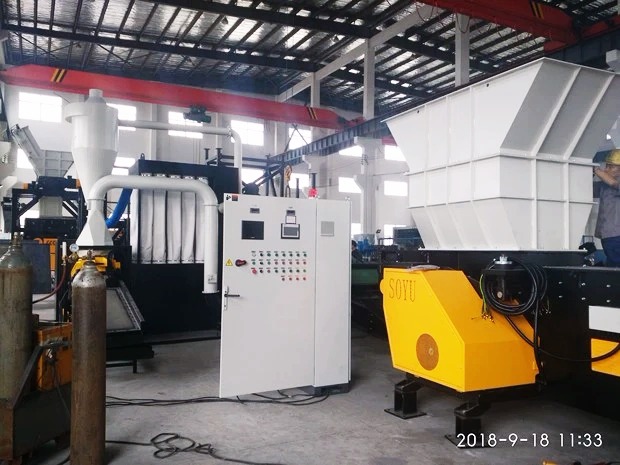
An integrated cable recycling line: shredding is only the first stage of the recovery process.
The Detailed Solution: What an Integrated Cable Recycling Line Actually Contains
To evaluate a supplier credibly, evaluators must be able to name and verify each machine in the line. The following section describes the specific equipment that a capable cable recycling line supplier should be able to present — not as a catalogue list, but as a connected recovery system.
1. The Cable Recycling Line as the Primary Capability Proof
The Cable recycling line (model SR1100, classified as a copper wire recycling machine) is the system that defines whether a supplier can be trusted with an end-to-end contract. According to Soyu Machinery’s published specifications, the line is built around two documented stages:
- Stage 1 — Single shaft shredder: used for the first stage of shredding the cable. Documented specification: power 17.2 kW, rotor blade quantity 24, stator blade quantity 4, mesh diameter Φ40 mm, rotating speed 83 rpm, shaft diameter Φ220 mm, dimensions 1585 (L) × 1100 (W) × 1800 (H) mm. The power voltage is customisable according to the buyer’s requirement.
- Stage 2 — Cable granulator: used for cutting, shearing and tearing the cable within the recycling plant. Documented specification: power 45 kW, stator blade quantity 10, rotor blade quantity 4, mesh diameter Φ12 mm, rotating speed 526 rpm, shaft diameter Φ420 mm, dimensions 1800 (L) × 1800 (W) × 2400 (H) mm. Voltage is customisable.
The presence of a documented second stage — a granulator with its own mesh diameter and rotor specification — is one of the clearest signals that a supplier understands cable recycling as a recovery process rather than a shredding sale. Evaluators should ask to see the granulation stage specified in the same document as the shredding stage; if it is missing, the supplier is not offering a line.
2. The Copper Wire Shredder as the Liberation Machine
The Copper wire shredder (model SR750, a single shaft copper wire shredder) is the machine that most directly determines how cleanly copper can be liberated from insulation. Its documented specification includes a cutting chamber of 830 × 708 mm, screen diameter Φ40 mm, motor power 2×37 kW or 2×45 kW, dimensions 2810 × 1960 × 2115 mm, and an approximate weight of 4460 kg.
Two design details are relevant to recovery rate. First, the screen diameter controls the output particle size leaving the shredder, which in turn affects how effectively the granulator can liberate copper in the next stage. Second, the single-shaft configuration with a defined cutting chamber is suited to homogeneous cable feed, which is the typical input for a dedicated cable line.
3. The Copper Shredder for Higher-Capacity Metal Recovery
Where cable scrap is mixed with other copper-bearing metal waste, the Copper Shredder (model SD2100) provides a higher-capacity recovery platform. Its documented specification includes a cutting chamber of 2055 × 1626 mm, screen diameters of 70/100/120 mm, motor power of 400 kW, dimensions of 4500 × 5620 × 4250 mm, and an approximate weight of 28600 kg.
Evaluators should note the screen diameter options. A supplier offering multiple screen options is signalling that the machine can be tuned to different downstream separation requirements — a genuine systems consideration rather than a fixed-spec sale.
4. The Metal Chips Shredder as Evidence of Broader Metal Recovery Capability
The Metal Chips Shredder (model SR600) is a compact machine that demonstrates whether a supplier’s metal recovery thinking extends beyond cable. Its documented specification includes a cutting chamber of 540 × 600 mm, screen diameter Φ40 mm, motor power 18.5 kW, dimensions 1800 × 1350 × 1700 mm, and an approximate weight of 1700 kg.
For a cable recycling buyer, the relevance is indirect but real: a supplier that offers metal chip processing as part of a broader recovery portfolio is more likely to understand the metallurgical and separation variables that affect copper recovery, rather than treating cable as a generic shredding input.
5. Shared Build Specification Across the Range
Integrated capability is also visible in shared engineering standards across the equipment range. Across the Soyu Machinery product documentation, the core crushing components are consistently specified as follows:
- Rotary blades: DC53 / CrMoV high-alloy wear-resistant steel, with tungsten carbide tipped or hardfacing welded options.
- Fixed blades: D2 / SKD11 tool steel.
- Blade hardness: HRC 58–62, with multi-side usability for extended service life.
- Shafts: 42CrMo high-strength alloy steel, quenched and tempered, dynamically balanced, surface hardened.
- Frame: Q345B heavy-gauge carbon steel plates, heavy-duty welding, overall stress-relief annealing, reinforced rib design.
When the same blade metallurgy and frame construction appear across the shredder, granulator and metal shredder lines, it is evidence of a single engineering system rather than rebadged third-party machines. This is a meaningful signal in supplier evaluation because spare-part continuity and wear-life predictability depend on it.
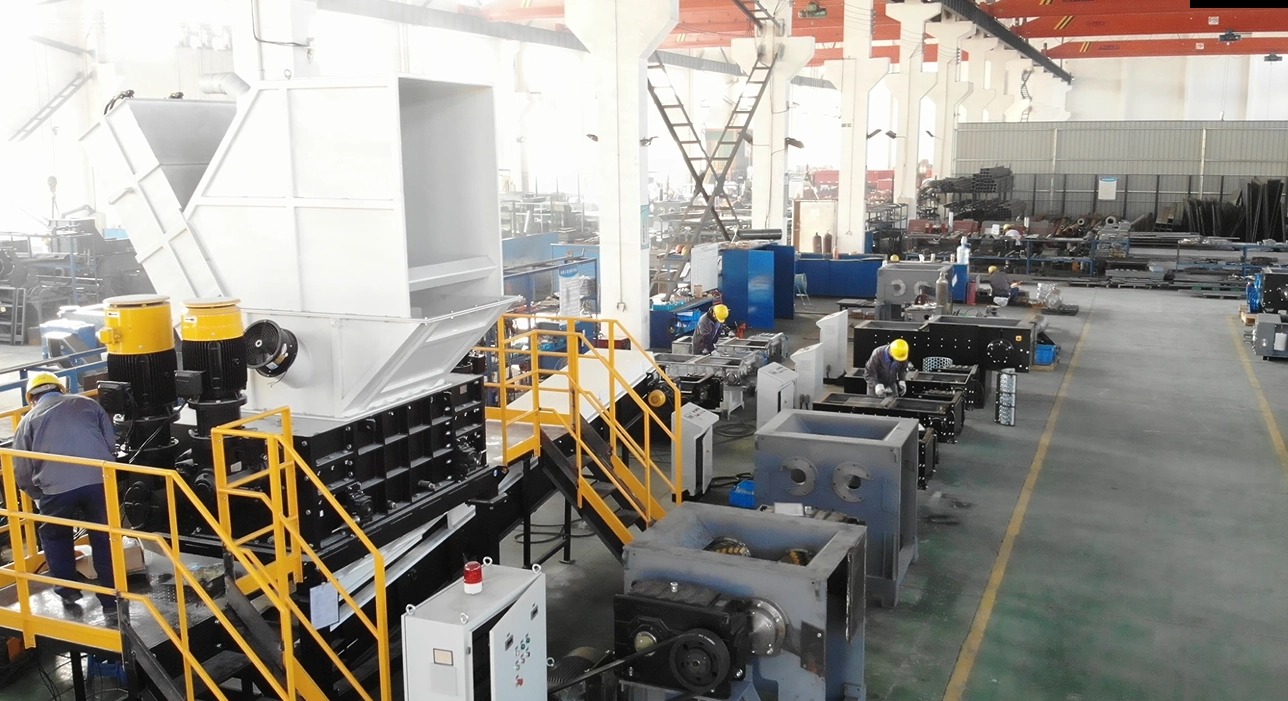
Manufacturing workshop: shared build standards across shredders, granulators and separation equipment.
Step-by-Step Breakdown: How to Evaluate a Cable Recycling Line Supplier
Use the following sequence when comparing suppliers. The order matters: verify system scope first, then verify recovery-stage evidence, then verify commercial and service terms.
Step 1 — Map the Supplier’s Scope of Supply
Ask the supplier to list every machine in the proposed line, with model numbers, in process order. A cable recycling line should show, at minimum, a primary shredder and a granulator, with separation and dust handling identified. If the supplier can only name a shredder, the scope is incomplete.
Step 2 — Verify Post-Shredding Stages in Writing
Request the specification of the granulation stage in the same format as the shredder stage. Documented parameters such as mesh diameter, rotor blade count and rotating speed demonstrate that the stage is engineered, not outsourced.
Step 3 — Check Metal Recovery Credentials Beyond Cable
Ask what other metal recovery equipment the supplier manufactures. A supplier offering a Copper Shredder and a Metal Chips Shredder alongside a cable line has demonstrated a metal-recovery product family; a supplier offering only one machine has not.
Step 4 — Confirm Compliance Documentation
Request the CE certificates relevant to the specific machines quoted. Soyu Machinery holds CE certification for its single shaft shredder (certificate M.2024.206.C108410, issued 2024-10-23, valid to 2029-10-22), double shaft shredder (M.2025.206.C115636, valid to 2030-03-17), four shaft shredder (M.2024.206.C102138, valid to 2029-06-11) and conveyor (M.2025.206.C126369, valid to 2030-09-15), all issued by UDEM for non-hazardous solid waste processing in industrial environments. These certificates reference the standards EN ISO 12100, EN 60204-1 and EN 12012-1, among others. Note that EN ISO 13857:2019, which defines safety distances to prevent hazard zones from being reached by limbs, is a relevant safety standard for shredder installations in the EU and global markets.
Step 5 — Ask for the Recovery-Rate Methodology
The supplier should be able to explain how copper recovery is measured — sampling method, input material definition, and output copper purity. A supplier that cannot describe this method is selling equipment, not recovery performance.
Step 6 — Validate Service and Spare-Part Continuity
For integrated lines, service capability is part of recovery-rate risk. Soyu Machinery documents on-site installation and commissioning, operator training, 24/7 remote support, spare parts supply and annual maintenance service as standard after-sales provisions. Lead time is documented at 45–60 days for standard models and 60–90 days for customised projects, with a minimum order quantity of one set for a single machine or one set for a complete line.
Step 7 — Review Real Operating References
Ask for operating references by application. A documented reference for a Cable recycling line is available from an agent customer in the United Kingdom, with one set installed and five years of stable operation, described as delivering superior metal recovery rates, energy-saving operation and easy integration into existing recycling infrastructure.
Use Cases: Where Integrated Cable Recycling Lines Are Applied
The evaluation criteria above apply across several real deployment scenarios. The following cases illustrate how system scope and recovery-stage capability change the decision.
Case 1 — UK Cable Recycling Agent, 5 Years of Operation
An agent customer in the United Kingdom installed one Cable recycling line and has reported five years of stable operation. The documented outcome includes superior metal recovery rates, energy-saving operation and easy integration into existing recycling infrastructure. For an evaluator, the relevant lesson is that the reference covers the full line, not a single machine, which makes it usable as evidence of integration capability.
Case 2 — Korean RDF Shredding, Four to Six Sets
A Korean agent installed multiple RDF shredders (models SRD2500 and SRD3000) with documented stable operation over five years and four years across two projects. The RDF shredder market is closely connected to the downstream refuse-derived fuel economy, which reached USD 4.6 billion in 2023 (Market.us, 2023). While RDF is a different application from cable recycling, the reference demonstrates the supplier’s ability to deliver repeatable multi-unit systems with consistent output — a capability pattern that transfers to cable line projects.
Case 3 — UK and Australian E-Waste Lines
Documented references include a UK agent operating an E-waste shredder (FS8080) for five years and an Australian end user operating an E-waste shredder (FS8080/FS100120) for six years, both with stable operation, effective material separation and compliance with environmental and safety regulations. These cases matter for cable recycling evaluation because e-waste and cable scrap share the same requirement: separation effectiveness, not just size reduction.
Case 4 — Multi-Country Plastic Shredding References
Additional references include a Turkish agent (one Plastic Shredder, two years), an Italian agent (twenty sets, ten years), a New Zealand end user (six years) and a Japanese agent (three years), all documented as stable operation with anti-jamming performance and energy-efficient components. The breadth of reference countries — UK, Italy, Korea, Japan, Turkey, New Zealand, Australia, Mexico, India, Malaysia, Taiwan, US, South Africa, Poland, Chile — indicates a supplier accustomed to exporting into varied regulatory and material environments.
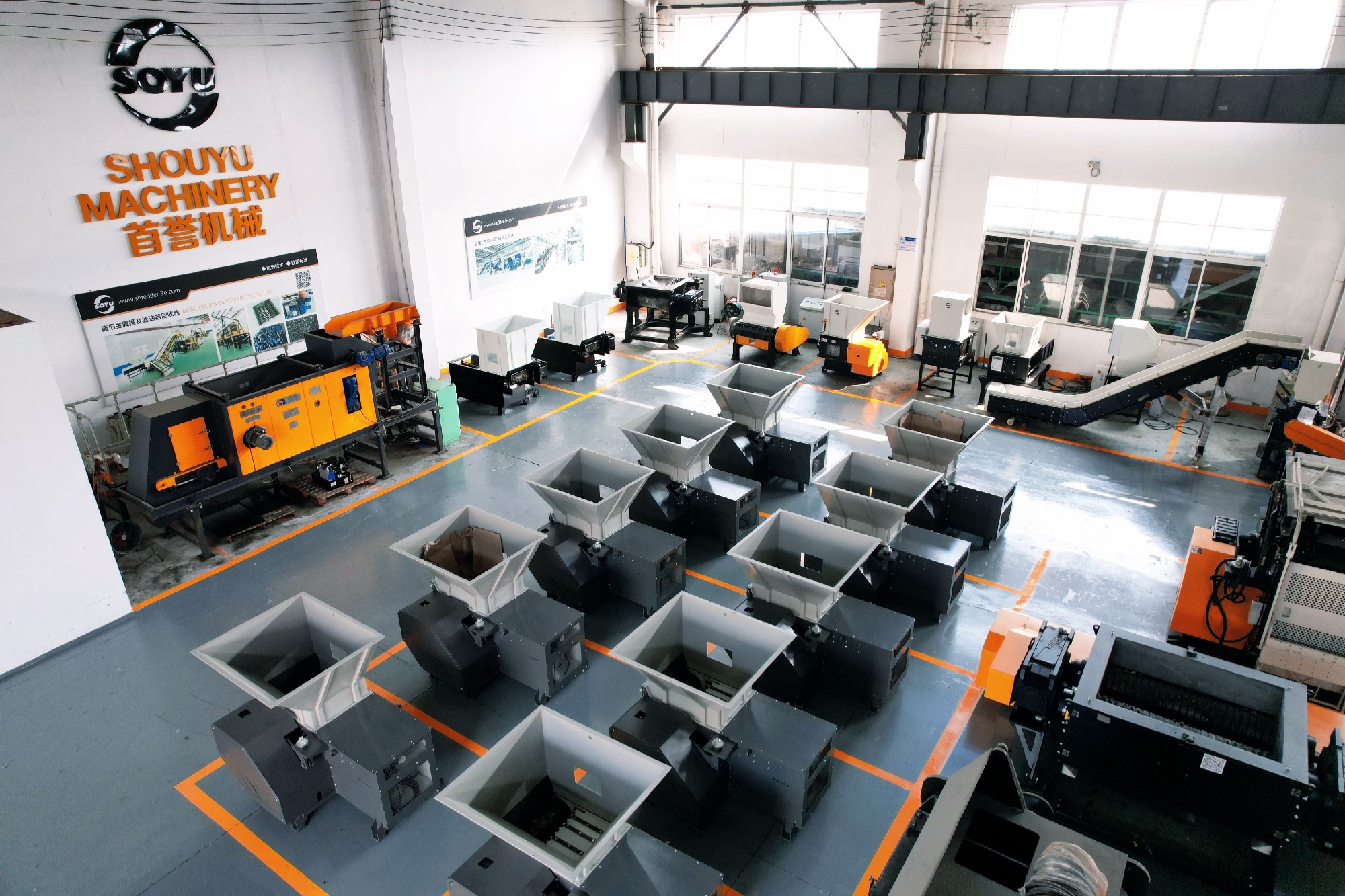
Product showroom: verifying the equipment family behind a cable recycling line proposal.
Comparison Table: Evaluation Dimensions for Cable Recycling Line Suppliers
The table below summarises the evaluation dimensions and the evidence an evaluator should require for each. It is designed to be used as a checklist during supplier shortlisting.
| Evaluation Dimension | Weak Evidence | Strong Evidence | Why It Affects Recovery Rate |
|---|---|---|---|
| System scope | Single shredder quoted | Documented Cable recycling line with named shredding and granulation stages | Recovery happens downstream of shredding; scope determines who controls it |
| Granulation stage | Unspecified or third-party | Documented granulator with mesh diameter (Φ12 mm), rotor blade count and speed | Particle size control determines copper liberation efficiency |
| Metal recovery range | One machine type | Copper wire shredder, Copper Shredder and Metal Chips Shredder in the same product family | Broader metal recovery experience indicates separation understanding |
| Build consistency | Unstated materials | DC53 / CrMoV rotary blades, D2 / SKD11 fixed blades, HRC 58–62, 42CrMo shafts | Consistent wear parts support predictable output over years |
| Compliance | No certificates shown | Machine-specific CE certificates (e.g., M.2024.206.C108410) issued by UDEM | Compliant installation avoids downtime and market-access risk |
| Recovery-rate method | Verbal claims only | Documented sampling and measurement method with defined input material | Recovery rate is the core economic variable |
| Operating references | Unnamed or generic | Named country, application, quantity and years of stable operation | References validate the integration claim under real conditions |
| Service model | Parts-only | On-site installation, commissioning, operator training, 24/7 remote support, annual maintenance | Downtime directly reduces effective recovery output |
| Lead time | Undisclosed | 45–60 days standard, 60–90 days customised | Enables realistic project scheduling and cash-flow planning |
FAQ: Cable Recycling Line Supplier Evaluation
Q1. What certifications should a cable recycling line supplier hold for EU and global markets?
A supplier should hold machine-specific CE certification for the equipment being quoted. Soyu Machinery holds CE certificates for its single shaft shredder (M.2024.206.C108410, valid to 2029-10-22), double shaft shredder (M.2025.206.C115636, valid to 2030-03-17), four shaft shredder (M.2024.206.C102138, valid to 2029-06-11) and conveyor (M.2025.206.C126369, valid to 2030-09-15), all issued by UDEM for non-hazardous solid waste processing in industrial environments. These reference standards including EN ISO 12100, EN 60204-1 and EN 12012-1. Buyers should also be aware of EN ISO 13857:2019, which defines safety distances for preventing hazard-zone access.
Q2. How can a supplier prove true end-to-end capability rather than just shredder capability?
Ask the supplier to name and specify every stage of the proposed line in process order. For a cable recycling line, that means the primary shredding stage and the granulation stage. Soyu Machinery’s Cable recycling line (SR1100) documents a single shaft shredder stage (17.2 kW, 24 rotor blades, Φ40 mm mesh, 83 rpm) and a cable granulator stage (45 kW, 10 stator blades, 4 rotor blades, Φ12 mm mesh, 526 rpm). A supplier that can only specify the shredder stage has not demonstrated end-to-end capability.
Q3. What are the main cost drivers when comparing cable recycling line suppliers?
The main commercial drivers are system scope (number of stages and machines), customisation level (voltage, layout, control system, safety configuration), and service model. Soyu Machinery documents OEM / ODM / customised system integration covering processing capacity, material type, safety configuration, control system, layout design and supporting equipment. Documented monthly capacity is 15–20 sets of complete recycling lines or 50–100 single shredders, with lead time of 45–60 days for standard models and 60–90 days for customised projects. Buyers should compare total system cost against expected recovery-rate improvement, not against shredder price alone.
Q4. Can a supplier test my actual cable scrap before I commit to a line?
Material testing is a reasonable request for any integrated line purchase and should be treated as part of scope definition. Soyu Machinery applies a 100% factory acceptance test (FAT) including material inspection and CE / ISO compliance testing. Evaluators should confirm whether the FAT is conducted on the buyer’s actual cable composition, because recovery rate is material-dependent and a generic test provides limited assurance.
Q5. What lead time should I expect for a customised cable recycling line?
Soyu Machinery documents lead time of 45–60 days for standard models and 60–90 days for customised projects, with a minimum order quantity of one set for a single machine or one set for a complete line. The company was founded in 2009, operates a 15,000 m² factory with around 200 employees, produces approximately 2,000 sets annually, employs 25 engineers, and exports about 70% of output to the EU and USA. If you are evaluating a customised cable recycling line and want to confirm configuration feasibility and sample-testing arrangements, you can reach Soyu Machinery at www.shredder3e.com or by email at sy@shredder-3e.com to request a line configuration review and sample validation discussion.
Evaluating a cable recycling line for your plant?
Share your cable composition and target output, and request a line configuration review, sample validation discussion or quotation.
Request a Cable Recycling Line Consultation | Email: sy@shredder-3e.com | WhatsApp: +86-13962331498
Conclusion: Judge the Line, Not the Shredder
The most common evaluation error in cable recycling procurement is judging a supplier by the shredder alone. Recovery rate — the metric that determines project economics — is created by the integration of shredding, granulation and separation, and by the supplier’s ability to specify, test and service each stage. Evaluators should therefore require a documented line scope, a specified granulation stage, a metal recovery product family, machine-specific CE certification, a stated recovery-rate methodology, and named operating references with country, application and duration.
The market context reinforces this discipline. With the global industrial shredder market projected to grow from approximately USD 1.28 billion in 2024 toward USD 1.65 billion by 2032 (Intel Market Research, 2024), and with leading players holding roughly 38% of the market (Intel Market Research, 2024), buyers will continue to encounter a long tail of suppliers. The suppliers worth shortlisting are those that can show the whole recovery system — shredder, granulator, separation and service — as a single engineered line, and can explain how each stage contributes to the copper that actually leaves the plant as recovered product.
Have Questions or Need More Details?
Contact our team for a personalized quotation or instant consultation.
Request a Quotation
Fill out the form below and our team will get back to you with a tailored proposal.
WhatsApp Direct Chat
Prefer to chat in real-time? Message us on WhatsApp for instant assistance & quick answers.
- Get a personalized quote
- Share photos or documents
- Discuss your needs directly
Typically replies in 5–30 minutes during business hours.