
Bulky Waste vs. Metal vs. E-Waste Shredders: A Side-by-Side Selection Comparison
Short answer: a bulky waste shredder is engineered around large, irregular, low-density items; a metal shredder or scrap metal crusher is engineered around dense, abrasive scrap that must be reduced and densified; an e-waste shredder is engineered as the first stage of a contained line that prepares electronics for downstream separation. The three families share blade metallurgy and frame design, but their feed envelopes, chamber sizes, drive power and supporting equipment are different. Selection is decided by feed geometry, contamination and the output specification of the next process stage, not by motor power alone.
This comparison is built on the shredder range of Changshu Shouyu Machinery Co., Ltd. (SOYU Machinery), a shredder manufacturer founded in 2009 with a 15,000 m2 factory, 200 employees, a 25-engineer R and D team and an annual output of around 2,000 sets, roughly 70% of which is exported to EU and USA markets. Because one company builds four shaft, double shaft, single shaft and hammer mill platforms, the three waste-stream categories can be compared on a single engineering baseline. Company details: www.shredder3e.com.
Problem Definition: Why These Three Categories Get Confused
All three machines tend to be described with the same four numbers: motor power, cutting chamber size, shaft configuration and machine weight. Those numbers do not tell a buyer which waste stream the machine was engineered to accept, which is where most specification mismatches originate.
- Bulky waste buyers often start from tons per hour, then discover that item geometry decides the outcome. A sofa frame, a mattress, wooden formwork or a plastic pallet behaves very differently from loose mixed waste, and bridging in the hopper is a geometry problem rather than a power problem.
- Metal buyers often start from motor power, then discover that the real cost drivers are downstream charge density, coating removal and blade wear on abrasive scrap.
- E-waste buyers often start from size reduction, then discover that the shredder is only one element of a contained process: magnetic separation, eddy current separation, dust extraction and hazardous-material containment determine whether output is saleable and whether the facility is compliant.
The practical consequence is that a machine can be technically capable of processing a material and still be the wrong purchase, because the configuration - screen aperture, shaft architecture, ram travel, discharge height, supporting equipment - was matched to a different stream.
Industry Background: What the Shredder Market Looks Like in 2026
Demand for industrial shredders is growing but fragmenting by waste stream. Intel Market Research valued the global industrial shredder market at approximately USD 1.28 billion in 2024 and projects USD 1.65 billion by 2032. Grand View Research reported that Asia Pacific held a 39.0% revenue share of the global metal shredder machine market in 2024, driven largely by Chinese scrap generation. Within that segment, twin shaft shredders accounted for a 35.0% revenue share in 2024, while the commercial four shaft shredder subsegment was estimated at USD 0.51 billion in 2025 with a 5.8% CAGR through 2034 (Dataintelo).
Downstream demand explains part of the pressure on buyers. The global refuse derived fuel (RDF) market - a process that depends on industrial shredders to prepare municipal solid waste - reached USD 4.6 billion in 2023 (Market.us), which is why high-torque single shaft and heavy-duty single shaft platforms keep appearing in buyer shortlists alongside conventional shredders.
Supply remains fragmented. The largest international players - Doppstadt, Vecoplan, Untha, Lindner Recyclingtech and Komptech - hold roughly 38% of the market combined (Intel Market Research). For buyers, that means sourcing is not only a machine decision: spare blade availability, service response and documentation quality vary widely across the remaining supply base.
Two regulatory facts shape procurement in the EU. Industrial shredders must respect the safety distances defined in EN ISO 13857:2019, and CE marking in this category is issued per machine platform rather than per company, so the certificate number must match the platform being purchased.
The Three Categories, Side by Side
1. Bulky Waste Shredder: Built for Volume, Irregularity and Mixed Contamination
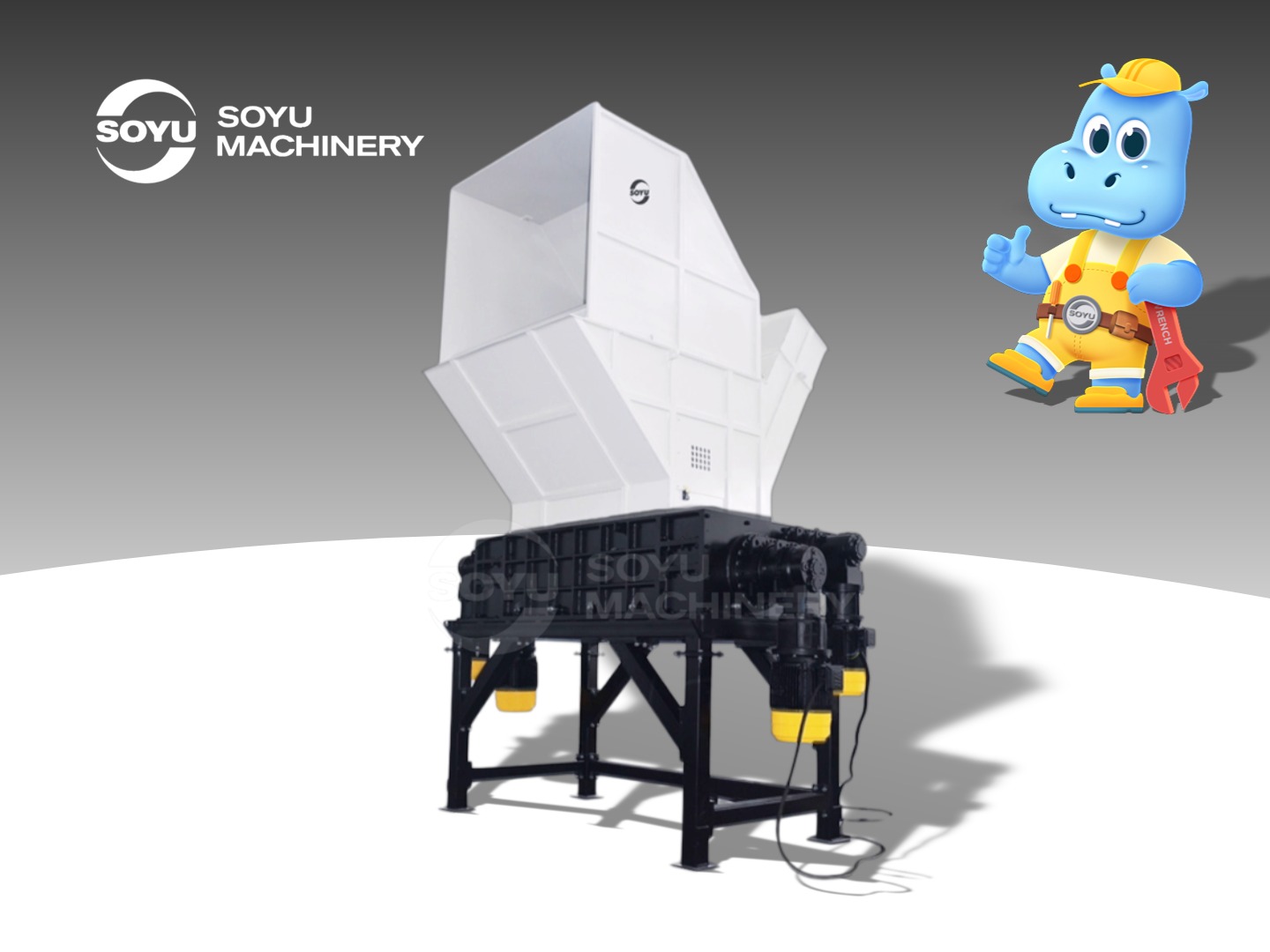
A bulky waste shredder focuses on reducing large, hollow, low-bulk-density items so they can be transported, sorted or converted into fuel. Typical feed materials are household bulky waste such as sofas and cabinets, construction waste such as wooden formwork and plastic templates, and industrial large-scale scrap; the same platform family also covers waste wood, pallets and wooden crates.
The reference model in this class is the FS130140 heavy-duty bulky waste shredder: 2x15 plus 2x37 kW drive, a 1300 x 1400 mm cutting chamber, 3850 x 2000 x 3100 mm overall dimensions and approximately 13,500 kg machine weight. Where items are heavier and more entangled, the twin-shaft low speed high torque platform SYU61210 (2x90 kW, 5400 x 2400 x 3700 mm, approximately 23,000 kg) provides a slower, higher-torque cut, and the four shaft FS160160 (2x30 plus 2x45 kW, 1600 x 1600 mm chamber) extends the same logic to larger volumes.
What the buyer is really purchasing is a first-stage volume reduction step: a stable, non-bridging infeed, a discharge size that suits a conveyor or baler, and a frame that tolerates tramp material such as steel reinforcement hidden inside furniture or construction waste.
2. Metal Shredder and Scrap Metal Crusher: Built for Density and Liberation
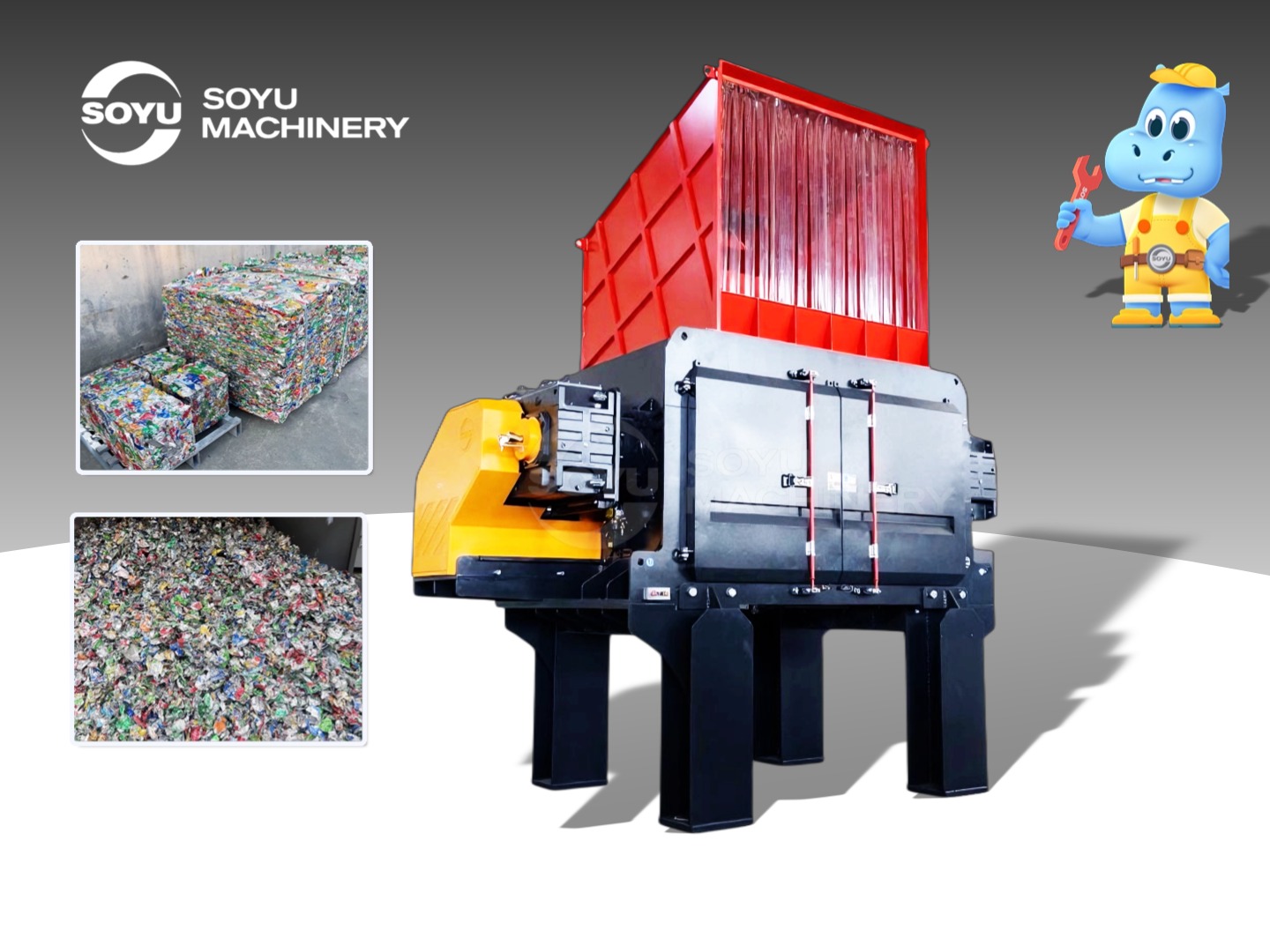
A metal shredder is selected for one of two outcomes, and the two outcomes require different machines. The first outcome is size reduction of mixed metal scrap: scrap steel, aluminium profiles, copper scrap, metal cans, steel wire, end-of-life vehicle frames, engine housings, wheel rims, reinforcing steel bars, scaffolding and white-goods shells. The second outcome is densification for steelmaking - turning loose light scrap into a high-quality furnace charge, removing surface coatings and raising bulk density so melting efficiency improves.
For the first outcome, SOYU builds the heavy-duty SD platform. The SD2100 uses a 400 kW drive with a 2055 x 1626 mm cutting chamber, 70/100/120 mm screen options, a 4500 x 5620 x 4250 mm footprint and approximately 28,600 kg weight. The SD3000 raises the chamber to 2550 x 1626 mm with a 4530 x 7100 x 4750 mm footprint at approximately 41,000 kg.
For the second outcome, the hammer mill and scrap metal crusher platform is the correct category rather than a shear-type shredder: TLJ130-315 (315 kW, 22,000 kg) and TLJ130-450 (450 kW, 28,000 kg), each with 24 hammer heads, 60/80/100 mm interchangeable screens and a 3900 x 3700 x 3770 mm footprint. These machines are engineered for continuous impact crushing and coating removal instead of shear cutting.
Metal sub-streams are handled by dedicated configurations of the same platforms: the heavy-duty aluminium shredder SD2100 and SD3000, the copper shredder SD2100, the copper wire shredder SR750 (830 x 708 mm chamber, 40 mm screen, 2x37 or 2x45 kW) and the two-stage cable recycling line SR1100, which combines a 17.2 kW shredder stage at 40 mm mesh with a 45 kW granulator stage at 12 mm mesh.
3. E-Waste Shredder: Built for Containment and Downstream Separation
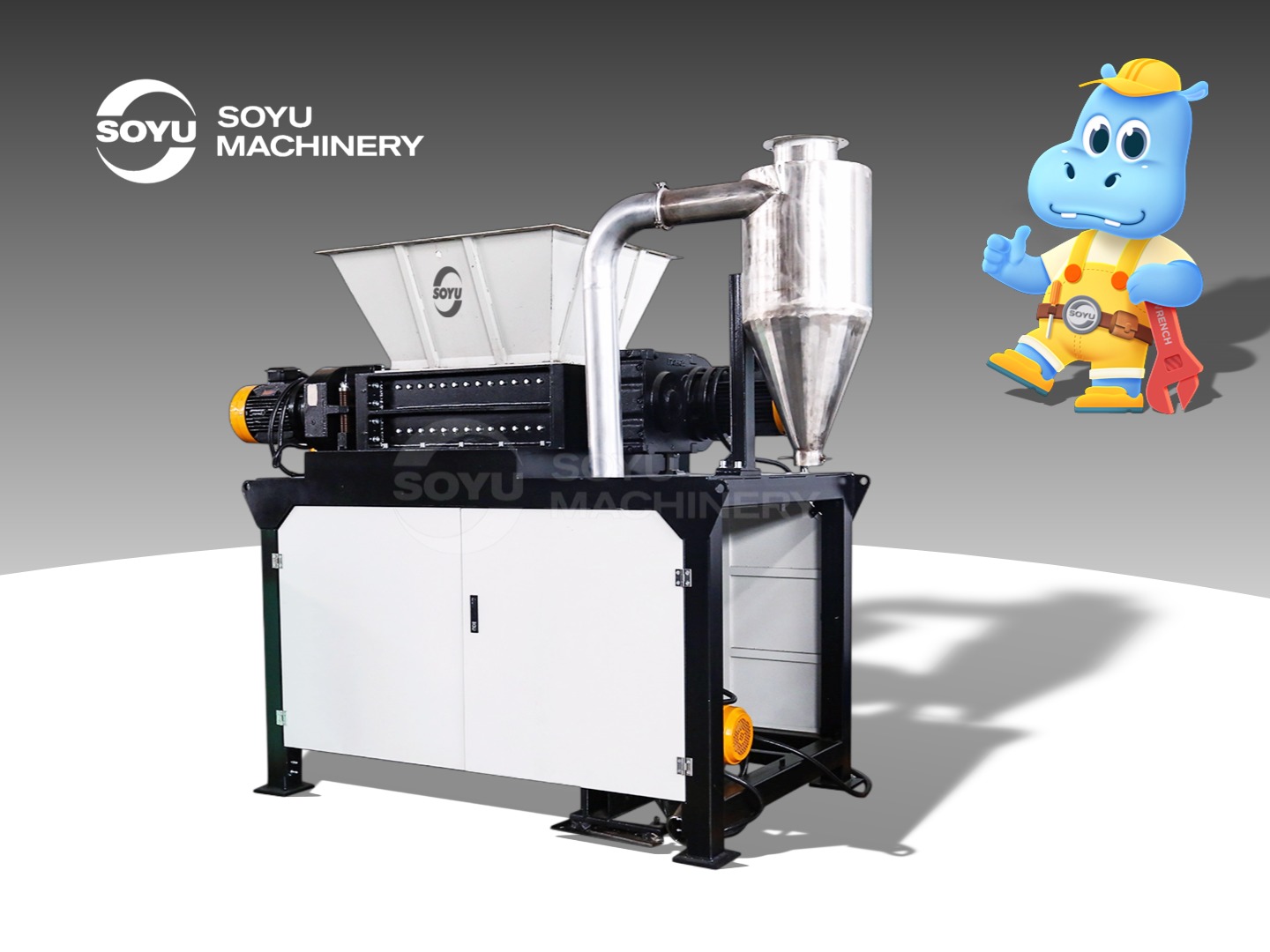
An e-waste shredder is the first stage of a controlled line rather than a standalone size-reduction machine. The feed is waste computers, mobile phones, circuit boards, power supply units and electronic components; the same four shaft platform also processes glass fibre reinforced plastics, PE and PP pipes, plastic barrels and ABS shells within the same facility.
Two models define the entry and mid range. The FS8080 uses 2x11 kW with an 800 x 800 mm cutting chamber, a 2360 x 1200 x 2065 mm footprint and approximately 2,000 kg weight. The FS100120 uses 2x30 kW with a 1000 x 1200 mm chamber, 3020 x 1800 x 2500 mm dimensions and approximately 6,000 kg weight.
What distinguishes this category in practice is the matched equipment around the shredder: conveyor belt, magnetic separator, eddy current separator, air classifier, dust extraction system, metal sorting system and hazardous material containment. Reference installations in the UK, the US, Japan and Australia operate enclosed, explosion-proof recycling facilities that comply with electronics recycling regulation and environmental standards, typically on a 10/5 or 16/5 schedule.

What Stays the Same Across All Three Families
Blade and frame engineering is deliberately shared, which is why category selection should be based on feed material and process objective rather than on build-quality claims. Across the range, rotary blades use DC53 or CrMoV high-alloy wear-resistant steel and fixed blades use D2 or SKD11 tool steel, with hardness in the HRC 58-62 band and multi-side reversible geometry that extends service life. Shafts are 42CrMo high-strength alloy steel, quenched and tempered, dynamically balanced and surface hardened. Frames are welded heavy-gauge carbon steel (Q345B in the single and four shaft lines, Q355B in the four shaft and hammer mill lines) with stress-relief annealing and reinforced ribs.
Step-by-Step: A Five-Step Selection Sequence
- Classify the feed stream by geometry and contamination, not by material name. Record maximum item dimensions, whether the stream contains hollow items, wires, rebar, liquids or batteries, and how much contamination is acceptable. A stream of sofas and formwork points to a four shaft or twin shaft platform; a stream of loose light steel points to a hammer mill; a stream of electronics points to a contained four shaft line.
- Define the output specification of the next stage. Transport and landfill volume reduction, sorting, RDF preparation, furnace charge and metal-plastic separation each imply a different discharge size and therefore a different screen aperture and shaft architecture.
- Choose the shaft architecture. Four shaft designs deliver single-pass reduction of bulky and mixed material. Twin shaft designs with a screen give controlled output size and high torque. Single shaft designs with a hydraulic ram, such as the SRD3000 (73-300 rpm, 270 mm ram travel, 3006 x 1620 mm chamber, 280 kW), suit film, RDF and mixed industrial waste where a ram maintains a steady feed. Hammer mills handle densification rather than shear cutting.
- Confirm the parameter set, not the headline power. Motor power, cutting chamber dimensions, screen aperture, discharge height, hydraulic power, total weight and footprint must all be checked together. In the four shaft FS130140 line, for example, the 1300 x 1400 mm chamber and 13,500 kg weight define the structural class of the machine, and the 2x15 plus 2x37 kW drive is sized to that chamber.
- Verify compliance, scope and delivery before comparing price. Confirm the CE certificate number that covers the specific platform and check it against EN ISO 13857:2019 safety distances. Then confirm customization scope, lead time and after-sales coverage, because these determine total cost of ownership after commissioning.
Customization is normally specified across six dimensions: processing capacity, material type, safety configuration, control system, layout design and supporting equipment. SOYU operates an OEM, ODM and customized system integration model with a monthly capacity of 15-20 complete recycling lines or 50-100 single shredders, which is the practical reason a configuration can be adapted rather than chosen from a fixed catalogue.
Use Cases: What Buyers Actually Build
Real configurations show how the three categories separate in daily operation rather than on a specification sheet.
- Bulky waste shredding system, United States. Two units based on the four shaft FS130140 bulky waste shredder, running 16/5 in a municipal solid waste environment, supported by a conveyor system, magnetic separator, air classifier, dust extraction system, baler and waste sorting station. Reported result: stable operation.
- E-waste shredding and recycling, Australia. A single machine end-user installation processing electronic waste with effective material separation, reported as stable operation over six years with low maintenance.
- E-waste recycling, Japan and United Kingdom. Agent-operated lines using e-waste shredders, reported as stable operation over six and five years respectively, integrated into existing electronics recycling systems.
- E-waste recycling, United States. End-user installation combining an e-waste shredder with separation and dust extraction equipment, reported as stable operation over four years.
- Aluminium scrap recycling, Mexico. Heavy-duty metal shredder platform operating under high load, reported as stable operation over three years.
One pattern is consistent across all of them: the shredder is sized to the feed, and the supporting equipment is sized to the output. Projects that fail usually inverted that relationship by choosing a machine first and designing the line around it afterwards.
Side-by-Side Specification Comparison
| Selection dimension | Bulky waste shredder | Metal shredder / scrap metal crusher | E-waste shredder |
|---|---|---|---|
| Primary role | First-stage volume reduction of large, irregular, low-density items | Size reduction and densification of dense, abrasive metal scrap | Contained first-stage reduction feeding separation and sorting |
| Reference models (SOYU) | FS130140 (four shaft) | SD2100 and SD3000; TLJ130-315 and TLJ130-450 hammer mill | FS8080 and FS100120 |
| Drive power | 2x15 + 2x37 kW | 400 kW (SD2100 and SD3000); 315 kW and 450 kW (TLJ) | 2x11 kW (FS8080); 2x30 kW (FS100120) |
| Cutting chamber / screen | 1300 x 1400 mm chamber | 2055 x 1626 mm (SD2100) and 2550 x 1626 mm (SD3000), screen 70/100/120 mm; hammer mill screen 60/80/100 mm | 800 x 800 mm (FS8080); 1000 x 1200 mm (FS100120) |
| Overall dimensions (mm) | 3850 x 2000 x 3100 | 4500 x 5620 x 4250 (SD2100); 4530 x 7100 x 4750 (SD3000); 3900 x 3700 x 3770 (TLJ) | 2360 x 1200 x 2065 (FS8080); 3020 x 1800 x 2500 (FS100120) |
| Machine weight | approx. 13,500 kg | approx. 28,600 kg (SD2100); approx. 41,000 kg (SD3000); 22,000 kg and 28,000 kg (TLJ) | approx. 2,000 kg (FS8080); approx. 6,000 kg (FS100120) |
| Typical feed | Household bulky waste, construction formwork, pallets, crates, industrial large-scale scrap | Scrap steel, aluminium profiles, copper scrap, end-of-life vehicle frames, wheel rims, rebar, appliance shells | Waste computers, mobile phones, circuit boards, power supply units, electronic components |
| Downstream outcome | Transportable, sortable or RDF-ready feedstock | Reduced, densified furnace charge or liberated metal fraction | Separated metal, plastic and contained hazardous fractions |
| CE certificate covering the platform | Four shaft: M.2024.206.C102138 (UDEM), issued 2024-06-12, valid to 2029-06-11 | Single shaft: M.2024.206.C108410, issued 2024-10-23, valid to 2029-10-22; hammer mill: M.2024.206.C105184, issued 2024-08-13, valid to 2029-08-12 | Covered by four shaft certificate M.2024.206.C102138, which lists the E-waste shredders FS8080 and FS100120 |
| Operating pattern in reference installations | 16/5 bulky waste system, United States | 16/7 high-load continuous operation, aluminium scrap, Mexico | 10/5 to 16/5 in UK, US, Japan and Australia electronics recycling facilities |
Because output depends on material mix, moisture and configuration, this comparison deliberately stays with verified machine parameters and certification records rather than estimated throughput figures. Buyers should ask suppliers to state parameters in the same format, then compare like for like.
FAQ: Bulky Waste, Metal and E-Waste Shredder Selection
Which certifications should a shredder hold for EU procurement?
EU procurement in this category is checked per machine platform, not per supplier. In the SOYU range, the four shaft platform that covers the bulky waste shredder FS130140 and the E-waste shredders FS8080 and FS100120 is certified under CE certificate M.2024.206.C102138, issued by UDEM on 2024-06-12 and valid to 2029-06-11, against EN ISO 12100:2010, EN 60204-1:2018, EN 12012-1:2018, EN IEC 61000-6-2:2019, EN IEC 61000-6-4:2019 and EN 13030:2019. The single shaft platform covering the metal shredders SD2100 and SD3000 is certified under M.2024.206.C108410, issued 2024-10-23 and valid to 2029-10-22, and the hammer mill and scrap metal crusher platform under M.2024.206.C105184, issued 2024-08-13 and valid to 2029-08-12. Buyers should also confirm compliance with EN ISO 13857:2019, which defines the safety distances that prevent hazard zones from being reached.
Can one shredder handle bulky waste, metal and e-waste, or are separate machines required?
The three categories are defined by feed envelope and downstream objective, so a single machine rarely covers all three well. The four shaft FS130140 platform is deliberately configured across several streams - bulky waste, solid waste, cardboard, FRP and wind turbine blade material - because these streams share large, low-density geometry and benefit from the same 1300 x 1400 mm chamber. Dense abrasive metal scrap needs the heavy-duty SD platform with a 400 kW drive and a 2055 x 1626 mm or 2550 x 1626 mm chamber, or a hammer mill where densification for steelmaking is the goal. Electronics need a contained line with magnetic and eddy current separation plus dust extraction. Blades and frames are shared across the families - DC53 or CrMoV rotary blades at HRC 58-62, D2 or SKD11 fixed blades, 42CrMo shafts, Q345B or Q355B frames - so the choice is about process fit, not about one platform being fundamentally better built.
What drives the cost difference between a bulky waste shredder and a metal shredder?
Cost differences follow four physical variables rather than brand tier. The first is drive power: the bulky waste shredder FS130140 uses 2x15 plus 2x37 kW, while the SD metal shredders use a single 400 kW drive and the TLJ hammer mill range uses 315 kW or 450 kW. The second is structural mass and chamber size, which scale with the loads involved: approximately 13,500 kg for the FS130140, approximately 28,600 kg for the SD2100, approximately 41,000 kg for the SD3000 and 22,000 to 28,000 kg for the TLJ hammer mills. The third is consumable metallurgy and wear protection on abrasive streams. The fourth is supporting equipment - conveyors, magnetic separators, eddy current separators, air classifiers, dust extraction and containment - which is proportionally larger in electronics lines than in bulky waste systems. Comparing quotations without these four items stated in the same format is the most common source of budget error.
Can a shredder configuration be validated against my own material before ordering?
Yes, and validation should be treated as a contractual step rather than a courtesy. SOYU applies 100% factory acceptance testing (FAT) plus material inspection and CE and ISO compliance testing before shipment, and the customization scope explicitly includes material type, processing capacity, safety configuration, control system, layout design and supporting equipment. In practice, buyers provide the feed material description, maximum item dimensions, contamination profile and the required output specification, the configuration is confirmed against those inputs, and the machine is verified against the agreed parameters at FAT. Buyers who want material-level evaluation before committing to a large line should raise this at inquiry stage, because the configuration that reaches FAT must reflect the stream the line will actually run.
What are the typical lead time and minimum order quantity?
For shredder and recycling line orders from this supply base, standard models carry a lead time of 45-60 days and customized projects 60-90 days. The minimum order quantity is one set for a single machine and one set for a complete line, and monthly capacity is 15-20 complete recycling lines or 50-100 single shredders. After-sales scope covers on-site installation and commissioning, operator training, 24/7 remote support, spare parts supply and an annual maintenance service. To move from comparison to a concrete configuration, send your feed material details and target output to sy@shredder-3e.com, call +86-512-52408453, or reach the sales team on WhatsApp at +86-13962331498.
Conclusion
Bulky waste shredders, metal shredders or scrap metal crushers, and e-waste shredders solve three different problems. The bulky waste platform exists to reduce volume and stabilise irregular feed; the metal platform exists to reduce and densify abrasive scrap into a charge or a liberated fraction; the e-waste platform exists to reduce electronics inside a contained line that separates materials and controls dust and hazardous fractions. Once the feed stream and the downstream output specification are written down, the shaft architecture, chamber size, screen aperture and supporting equipment follow logically, and the CE certificate for the specific platform becomes a checklist item rather than a sales claim.
SOYU Machinery manufactures all three families on shared blade and frame engineering from a 15,000 m2 facility with a 25-engineer R and D team and a 70% export share into EU and USA markets, which makes a like-for-like comparison possible. Full platform data and configuration options are available at www.shredder3e.com.
Next step
If you are evaluating shredder categories for a specific waste stream, the fastest route is a configuration review rather than a catalogue comparison. Send the feed material description, maximum item dimensions and the required output specification, and the appropriate platform - four shaft, twin shaft, single shaft or hammer mill - can be matched with the right chamber, power and screen aperture.
Email: sy@shredder-3e.com | Tel: +86-512-52408453 | WhatsApp: +86-13962331498 | Web: www.shredder3e.com
Have Questions or Need More Details?
Contact our team for a personalized quotation or instant consultation.
Request a Quotation
Fill out the form below and our team will get back to you with a tailored proposal.
WhatsApp Direct Chat
Prefer to chat in real-time? Message us on WhatsApp for instant assistance & quick answers.
- Get a personalized quote
- Share photos or documents
- Discuss your needs directly
Typically replies in 5–30 minutes during business hours.