From Line to Logs: Adapting Wood Shredder Solutions for Pallet and FRP Waste Streams
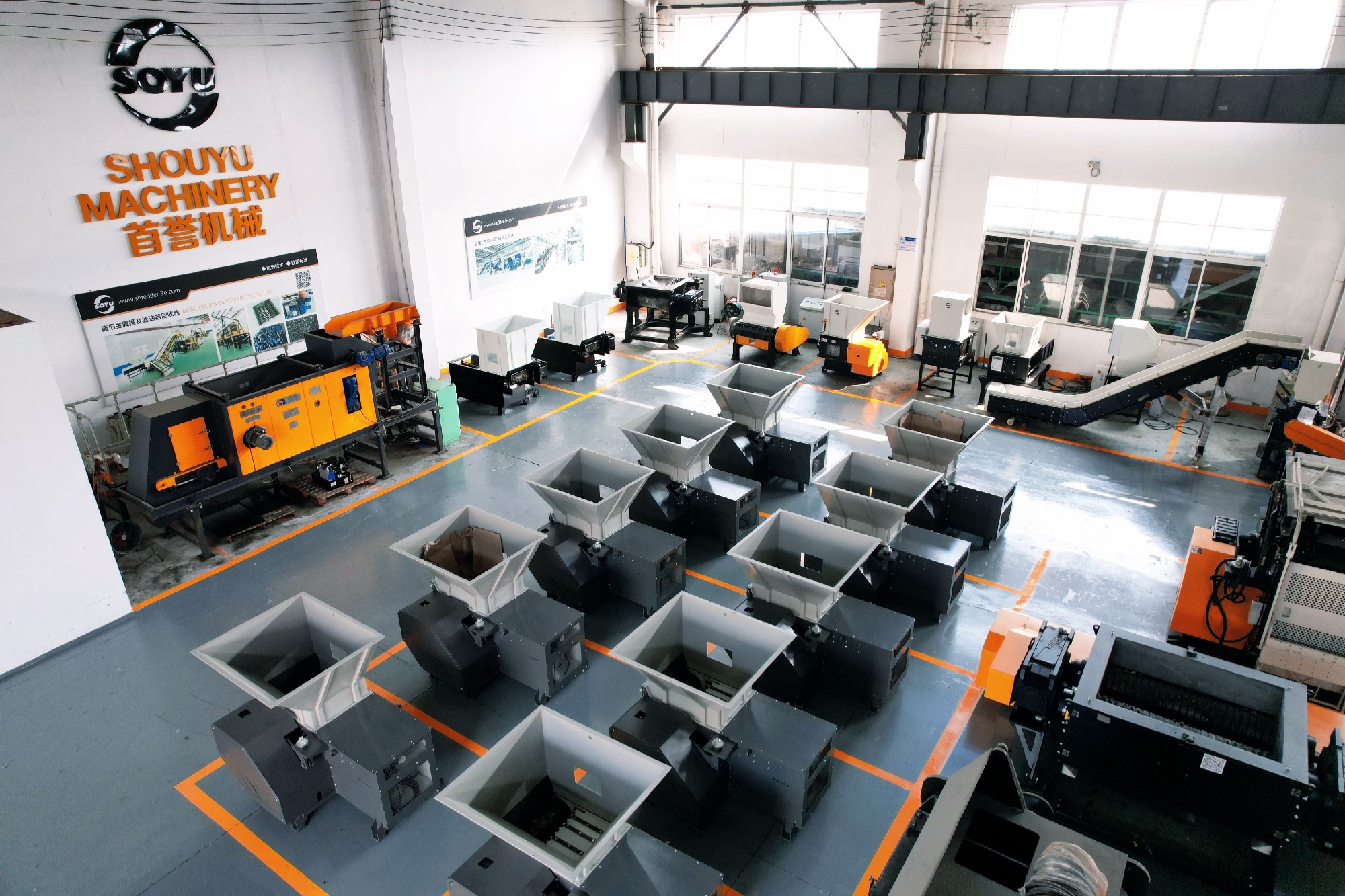
Industrial shredder configurations for wood pallet and FRP waste streams — SOYU Machinery showroom.
Wood pallets and FRP (fiberglass-reinforced plastic) scrap are two different waste problems that converge on one decision: how the shredding line is specified. Pallets arrive dry, bulky, low in bulk density and loaded with nails, staples and steel banding. FRP arrives dense, abrasive and dusty, with a resilient composite structure that resists simple size reduction. Running both through one underspecified machine is one of the fastest ways to turn a recycling contract into a maintenance schedule.
This guide is written for procurement officers, plant engineers and recycling operators who have already moved past supplier shortlisting and are now sizing a line. It explains how the Wood Shredder, the Wood Pallet Shredder and the FRP Shredder are applied in real project configurations, how single-shaft, double-shaft and four-shaft platforms divide the work, and how the supplier relationship chosen at the drawing stage shapes plant performance years after commissioning.
Soyu Machinery (Changshu Shouyu Machinery Co., Ltd.) is a shredder manufacturer founded in 2009 in Changshu, China, specializing in the R&D and manufacturing of single-shaft, double-shaft and four-shaft shredder equipment. Its range covers wood shredders, fiberglass shredders, metal shredders, plastic shredders, RDF shredders and waste paper shredders — a portfolio that matters when one site has to process several material families. Approximately 70% of that output is exported to the EU and USA, and the company operates a 15,000 m² facility with around 200 employees, an R&D team of 25 engineers and an annual output of 2,000 sets.
Problem Definition: Why Pallet and FRP Streams Resist a Single Specification
Answer-first: the difficulty is not shredding wood or shredding composite material on its own. It is that these two streams fail a shredder in opposite ways, so a specification written around one becomes a bottleneck for the other.
Bulk density and feed behaviour
Pallet wood is dimensionally large but low in bulk density. Throughput on a pallet stream is usually limited by feeding and material handling rather than by rotor power, because the machine can consume volume faster than a loading system can present it. FRP behaves in the opposite way: dense, heavy per unit volume and abrasive, so the load per revolution is higher and wear is continuous rather than occasional. A hopper and drive sized for one of these materials will routinely be wrong for the other.
Contamination and wear
Pallet streams carry nails, staples, screws, banding and, frequently, plastic wrap or concrete debris. FRP streams carry abrasive glass fibre and cured resin dust that behaves quite differently from wood dust. Within documented shredding risk profiles, material jamming overload, mechanical injury and dust-related hazards are recognized failure categories, and the control measures typically applied to them include overload protection systems, dust extraction, safety interlocks and emergency stop functions. Where batteries or e-waste enter the same line, explosion-proof design becomes part of the specification rather than an optional extra.
The output specification decides everything downstream
The acceptable output size is set by the offtake, not by the machine. Boiler fuel, refuse-derived fuel feedstock, panel or board feedstock, compost bulking agent and simple landfill volume reduction all accept different particle profiles. A configuration that produces a perfectly acceptable fuel product may be unusable for a panel press. This is why the reduction stage should be specified backwards from the receiving process, not forwards from the equipment catalogue.
The lifecycle problem hiding behind the purchase
Streams change. A pallet recycler wins a composite demolition account; an RDF line starts accepting mixed construction and demolition wood; a fabricator begins taking back end-of-life parts. Because of this, the useful question at the Decision and Execution stage is not “which machine shreds pallets” but “which configuration, supplier and service structure can absorb the next three material changes without a new capital project”. That is the ecosystem question, and it is the one this guide answers last but weighs most heavily.
Industry Background: Where the Volume Is Coming From
Industrial shredding demand is being pulled from two directions: general waste-volume growth and specific downstream markets that need shredded material as an input.
- The global industrial shredder market was valued at approximately USD 1.28 billion in 2024 and is projected to reach USD 1.65 billion by 2032 (Intel Market Research).
- The commercial four-shaft shredder segment alone is estimated at USD 0.51 billion in 2025, growing at a CAGR of 5.8% through 2034 (Dataintelo).
- Twin-shaft shredders held a 35.0% revenue share of the metal shredder machine market in 2024 (Grand View Research), which indicates how dominant multi-shaft platforms have become for mixed and contaminated loads.
- Asia Pacific accounted for a 39.0% revenue share of the metal shredder machine industry in 2024, led by China's scrap generation volume (Grand View Research).
- The refuse-derived fuel (RDF) market, which depends on industrial shredders to process municipal solid waste, reached USD 4.6 billion in 2023 (Market.us).
- Doppstadt, Vecoplan, Untha, Lindner Recyclingtech and Komptech together hold roughly 38% of the global industrial shredder market (Intel Market Research), leaving the majority of demand to regional and specialized manufacturers.
The practical implication for a buyer is this: with a fragmented supplier base and a broadening downstream demand profile, machine specification quality and long-term support structure separate projects that run for a decade from projects that are re-tendered every few years.
Detailed Solution: Matching Wood and FRP Streams to the Right Reduction Platform
Three product families do most of the work in wood-and-composite recycling: the Wood Shredder for general wood waste, the Wood Pallet Shredder for pallet and crate streams, and the FRP Shredder for fiberglass-reinforced composite scrap. Around them sit the drive platforms — single-shaft, double-shaft and four-shaft — together with feed, discharge and dust-control equipment.
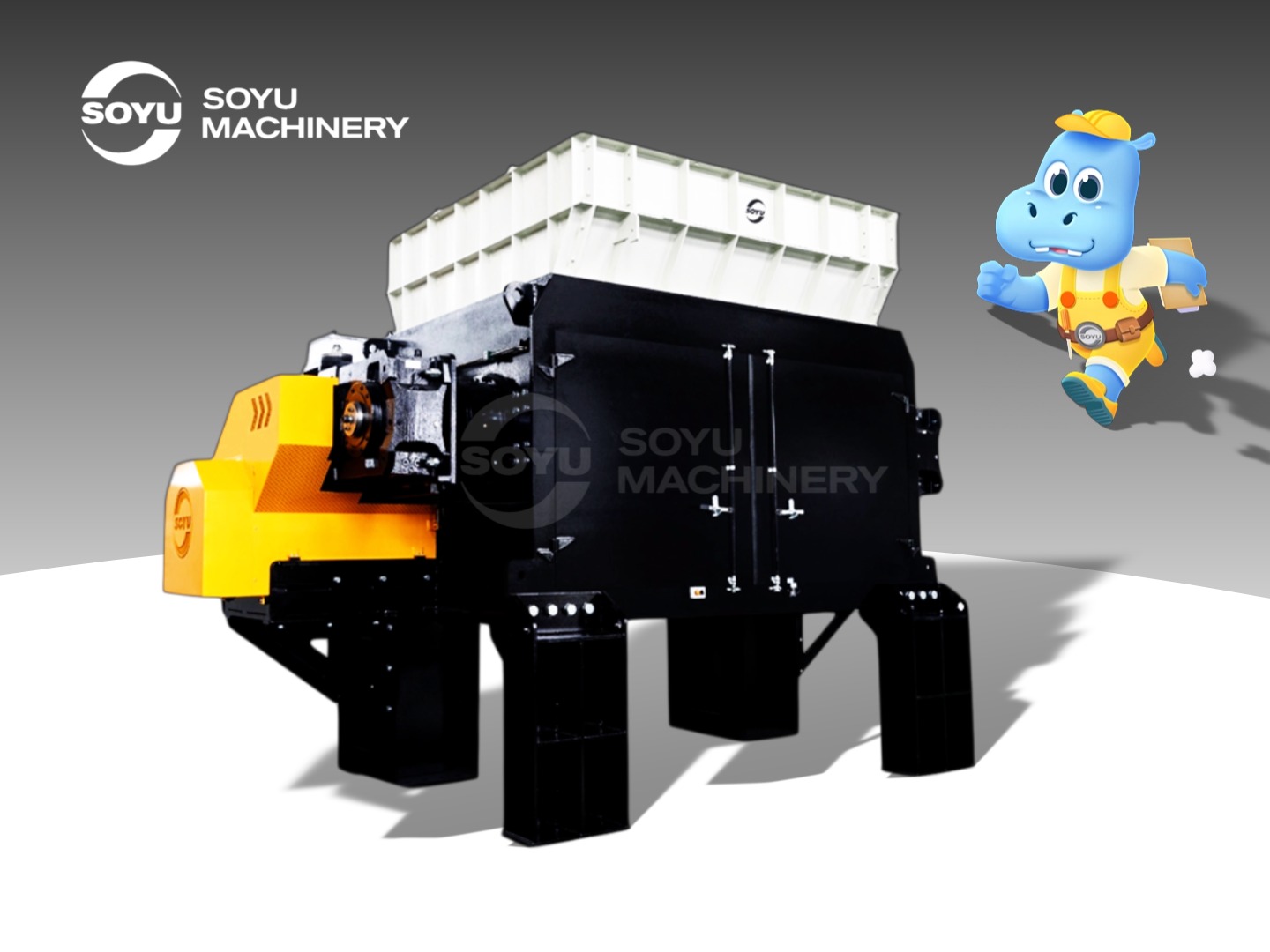
A reduction unit specified for mixed wood and composite streams.
Wood Shredder: general wood waste
This is the workhorse for streams that are wood but not uniform — demolition timber, crates, pallet offcuts, pallet manufacturing rejects and green waste wood. The specification priority here is tolerance to variation. Buyers should expect to define a working envelope of material rather than a single accepted item, and should size the feed system for the bulkiest item that will realistically arrive, not the average one.
Wood Pallet Shredder: pallet and crate streams
Pallet streams are repetitive in dimension, which allows a more targeted design. In practice, a dedicated Wood Pallet Shredder is specified to accept whole pallets without pre-cutting, to tolerate repeated fastener loads, and to deliver a defined output band for the downstream offtake. Because pallet supply is usually contract-driven and continuous, uptime matters more than peak throughput: a machine that stops twice a shift for jam clearance will underperform a slower machine that runs continuously.
FRP Shredder: fiberglass and composite scrap
The FRP Shredder addresses composite manufacturing offcuts, decommissioned composite parts and end-of-life fiberglass components. The dominant engineering concerns are abrasive wear and dust generation, not throughput. Blade and rotor wear protection, dust extraction and containment typically matter more to the total operating cost than the headline capacity figure, and the machine's output is usually destined for volume reduction ahead of disposal or co-processing rather than for a demanding secondary product specification.
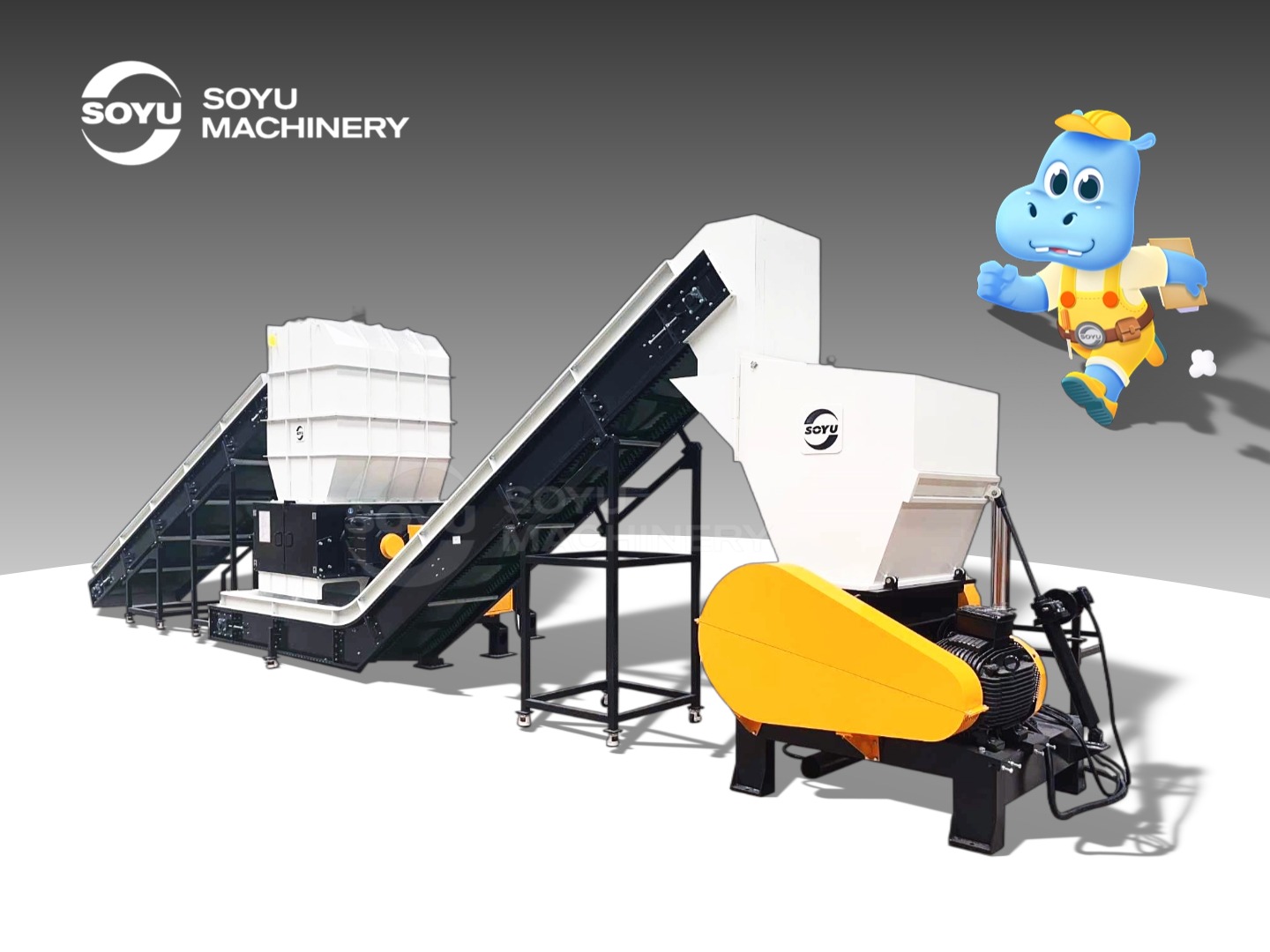
Multi-shaft shredder platforms support both primary reduction and sizing duty in the same line.
The drive platform decides whether the line works
Machinery names describe the material; the drive platform describes the behaviour. Four configurations dominate commercial specifications:
- Single shaft shredder — a hydraulic ram feeds material into the rotor, allowing feed rate to be controlled rather than left to gravity. Published specification data for the Soyu SR1400 single-shaft shredder lists a rotor speed of 73 rpm combined with hydraulic ram feeding, which illustrates how this platform trades rotor speed against controlled, uniform feed. It suits more homogeneous streams.
- Double shaft shredder — two counter-rotating shafts carry out coarse primary reduction and tolerate contamination better than most alternatives. This is the configuration behind twin-shaft designs holding a 35.0% revenue share of the metal shredder machine market in 2024.
- Four shaft shredder — two reduction stages inside a single frame, used where the output band has to be tighter and the stream is mixed. The commercial four-shaft segment is estimated at USD 0.51 billion in 2025 and is growing at 5.8% annually through 2034.
- Low speed high torque shredder — the configuration usually chosen when torque demand, contamination and jamming risk are the dominant constraints rather than throughput.
Safety and control package
Documented shredding risk types include material jamming overload, hazardous material explosion (battery and e-waste inputs), dust explosion, mechanical injury and electrical failure. The documented control methods are overload protection systems, explosion-proof design, dust extraction systems, safety interlocks, emergency stop and leakage detection. Soyu's stated enterprise measures include load sensors, explosion-proof motors, safety guards, CE/ISO certification, regular safety audits, operator training and a real-time monitoring system. For equipment destined for European installations, EN ISO 13857:2019 defines the safety distances required to prevent hazard zones from being reached by limbs, and it should be referenced explicitly in the technical agreement.
Execution readiness and capacity
Production capacity matters at the Execution stage because it determines whether a line can be delivered alongside a site-build programme. Soyu Machinery's documented monthly production capacity is 15–20 complete recycling lines or 50–100 single shredders. Documented commercial terms include a minimum order quantity of 1 set (single machine) or 1 set (complete recycling line), FOB delivery terms, and payment terms of 30/70.
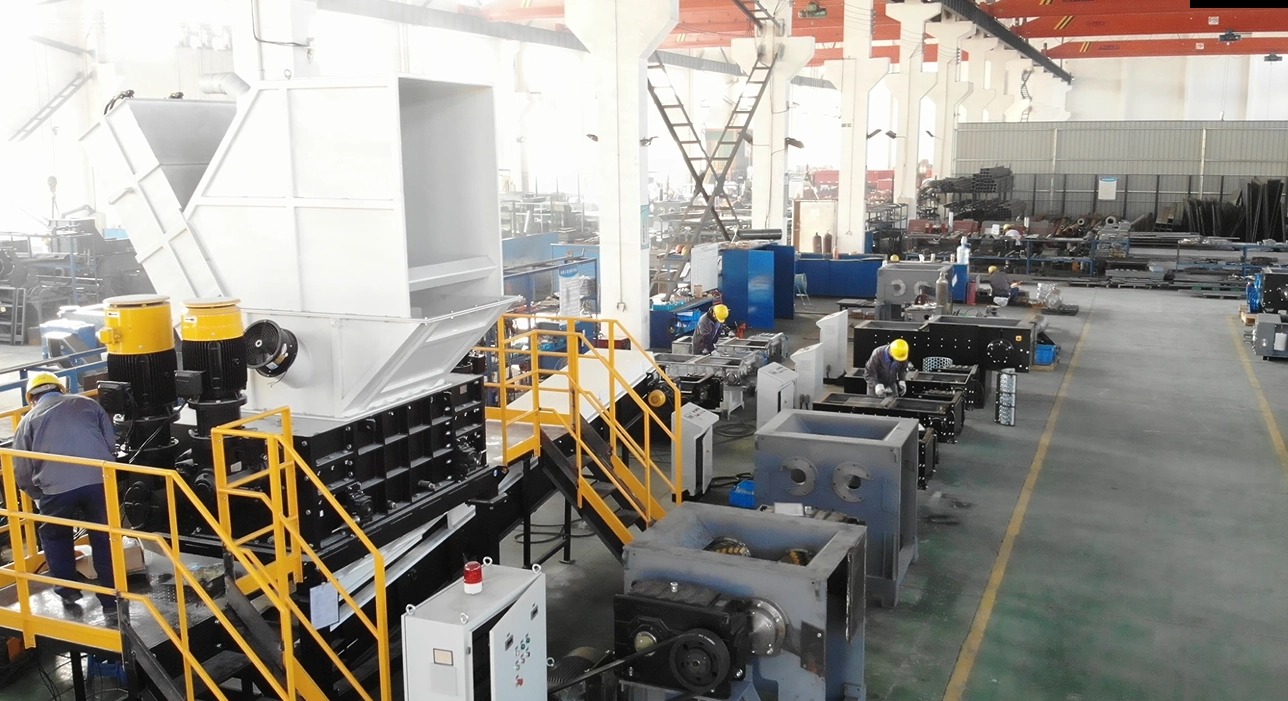
Assembly workshop — configurations are built to project specification rather than taken from stock.
The long-term layer
SOYU's published comparison data, positioned against foreign-brand recycling equipment and traditional manual dismantling plus general crusher configurations, reports +20% processing capacity, 15–20% lower initial investment, 25% lower long-term operating cost, 30% lower maintenance cost, 30% lower downtime and approximately 10% lower energy consumption per ton of treated material. The same source describes best-fit applications as large-scale industrial waste recycling, hazardous material treatment, customized recycling projects and cost-sensitive overseas markets including the EU, the Middle East and Southeast Asia, supported by faster spare parts supply and 24/7 remote troubleshooting. These figures are manufacturer-published and should be re-tested against a buyer's own tariff, freight, labour, energy and downtime assumptions before they enter a business case — but the service structure they describe is the part that determines years six through ten of ownership.
Step-by-Step Breakdown: From Stream Audit to Commissioned Line
Step 1 — Audit the stream, not the material name
Characterize what actually arrives: whole pallets or pre-broken timber, nail and banding density, moisture content, seasonal variation, and the proportion of non-wood contamination. FRP should be characterized separately by thickness, resin content and dust behaviour. Two “wood” accounts can require different platforms once this audit is complete.
Step 2 — Work backwards from the offtake
Define the receiving process and its accepted input range before selecting any equipment. Boiler fuel, RDF feedstock, panel feedstock and landfill volume reduction each impose different output requirements, and this step determines whether the line needs one reduction stage or two.
Step 3 — Select the reduction platform
Match drive architecture to the constraint that dominates the application: controlled feed for homogeneous pallet streams (single shaft with hydraulic ram), coarse primary reduction with contamination tolerance (double shaft), tighter output band on mixed material (four shaft), or maximum torque resistance to jamming (low speed high torque). Where pallet wood and FRP must both be processed, two dedicated units — a Wood Pallet Shredder and an FRP Shredder — are usually the more durable answer than one compromise machine.
Step 4 — Specify feed, discharge and dust control
Pallet streams need feeding equipment sized for the bulkiest item; FRP streams need dust extraction and containment designed around abrasive particulate. Screens, conveyors, separation of ferrous fasteners and the discharge interface to the next process all belong in this step, not in a later variation order.
Step 5 — Lock the compliance and safety package
Confirm in writing which control measures are included: overload protection, explosion-proof design where battery or e-waste material may be present, dust extraction, safety interlock, emergency stop and leakage detection, plus the CE/ISO documentation set and EN ISO 13857:2019 safety-distance compliance for EU installations. Undocumented assumptions are the most common source of commissioning delay.
Step 6 — Plan the operating ecosystem
Agree acceptance testing, commissioning support, operator training, spare-parts availability and remote diagnostics before the purchase order is issued. Acceptance criteria for this stage typically include a 100% Factory Acceptance Test (FAT), on-site commissioning and acceptance, and third-party inspection by SGS or BV. This step is what converts a machine purchase into an operating asset.
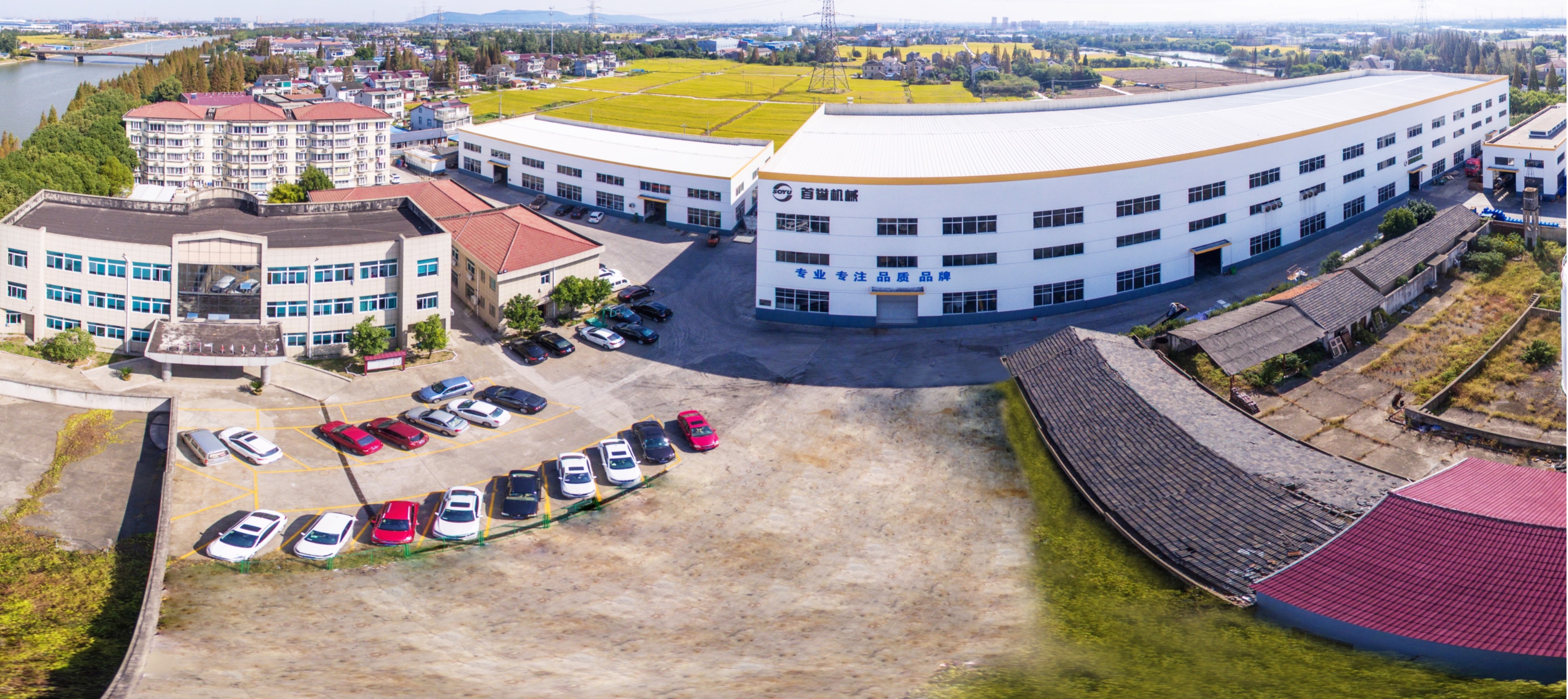
Manufacturing base in Changshu — 15,000 m² with around 200 employees and a 25-engineer R&D team.
Use Cases: Three Project Profiles
Case 1 — Pallet recycling and distribution-centre returns
Requirement: continuous intake of whole pallets with embedded nails and banding; output for a boiler fuel or panel feedstock offtake; minimal unplanned stoppages across a multi-shift schedule.
Configuration logic: a dedicated Wood Pallet Shredder with a feed system designed around whole-pallet dimensions, plus ferrous separation downstream.
Long-term consideration: wear parts and the ability to accept occasional non-pallet wood without re-engineering the feed.
Case 2 — Composite fabricator scrap and end-of-life FRP parts
Requirement: volume reduction of abrasive composite offcuts and decommissioned parts, with dust containment treated as a primary design constraint rather than a nuisance.
Configuration logic: an FRP Shredder specified around wear protection and dust extraction, with output destined for disposal or co-processing rather than a tight product specification.
Long-term consideration: blade and rotor wear cost per ton is the metric that matters, which makes spare-parts supply and remote troubleshooting part of the procurement decision.
Case 3 — Mixed wood and C&D line feeding an RDF or fuel operation
Requirement: primary reduction of bulky, contaminated mixed wood followed by a sizing stage to reach the receiving process specification.
Configuration logic: a double-shaft or four-shaft platform for primary reduction, with the second stage sized on the output band.
Long-term consideration: the RDF market reached USD 4.6 billion in 2023, and offtake specifications in this sector tend to tighten over time. A line that can be re-screened and re-tuned without replacing the primary shredder is worth more than a marginally cheaper fixed configuration.
Comparison Tables
Table 1 — Reduction platform fit for wood and FRP streams
| Platform | Typical role in wood and composite streams | Documented data point |
|---|---|---|
| Single shaft shredder | Controlled feed for more homogeneous streams; hydraulic ram drives material into the rotor | Published specification for the Soyu SR1400 lists a rotor speed of 73 rpm with hydraulic ram feeding |
| Double shaft shredder | Coarse primary reduction of bulky and mixed loads; higher tolerance of contamination | Twin-shaft designs held a 35.0% revenue share of the metal shredder machine market in 2024 (Grand View Research) |
| Four shaft shredder | Two-stage reduction for a tighter output band on mixed material | Commercial four-shaft segment estimated at USD 0.51 billion in 2025, growing at 5.8% CAGR through 2034 (Dataintelo) |
| Low speed high torque shredder | Chosen where torque demand, contamination and jamming risk dominate over throughput | Configuration principle, not a separate platform |
Table 2 — SOYU published comparison data
The table below reproduces comparison data published by Soyu Machinery for its customized configurations, positioned against foreign-brand recycling equipment and traditional manual dismantling plus general crusher alternatives.
| Comparison dimension | Documented position |
|---|---|
| Processing capacity | +20% |
| Initial investment | 15–20% lower |
| Long-term operating cost | 25% lower |
| Maintenance cost | 30% lower |
| Downtime | 30% lower |
| Energy consumption per ton treated | Approximately 10% lower |
| Best-fit applications | Large-scale industrial waste recycling; hazardous material (battery / e-waste) treatment; customized recycling projects; cost-sensitive overseas markets (EU, Middle East, Southeast Asia) |
| Service model | Faster spare parts supply; 24/7 remote troubleshooting support |
FAQ
1. What compliance requirements apply to a wood or FRP shredder installed in the EU?
Equipment installed in the EU must address the safety distances defined in EN ISO 13857:2019, which specifies the distances required to prevent limbs from reaching hazard zones on machinery. Beyond that standard, documented shredding risk types include material jamming overload, hazardous material (battery and e-waste) explosion, dust explosion, mechanical injury and electrical failure. The corresponding control package consists of an overload protection system, explosion-proof design where battery or e-waste material may be present, a dust extraction system, safety interlock, emergency stop and leakage detection. Soyu Machinery's documented enterprise measures include load sensors, explosion-proof motors, safety guards, CE/ISO certification, regular safety audits, operator training and a real-time monitoring system. Procurement teams should confirm in the technical agreement which of these measures are included in the quotation rather than assuming them.
2. Can one supplier handle both pallet wood and FRP in a single project?
Yes, within limits. Soyu Machinery manufactures wood shredders, fiberglass (FRP) shredders, single-shaft, double-shaft and four-shaft shredders, metal shredders, plastic shredders and RDF shredders, and provides customized shredding solutions for global customers. In practice, pallet streams and FRP streams are usually handled by separate reduction stages rather than by one universal machine, because the two materials demand different wear protection, dust control and feed behaviour. A project spanning both streams is therefore specified as two configurations sharing a single supplier relationship, one service agreement and one spare-parts strategy. Documented monthly production capacity of 15–20 complete recycling lines or 50–100 single shredders is what allows both units to be scheduled within one delivery programme.
3. What cost difference should a buyer expect between Chinese-manufactured and foreign-brand shredding equipment?
SOYU's published comparison data positions its customized configurations at 15–20% lower initial investment and 25% lower long-term operating cost against foreign-brand recycling equipment, with maintenance cost 30% lower, downtime 30% lower, processing capacity about 20% higher and energy consumption per ton of treated material approximately 10% lower. These are manufacturer-published figures. The useful procurement exercise is not to accept or dismiss them, but to rebuild the same comparison using your own labour rates, energy tariffs, freight, duties and realistic downtime assumptions — at which point the difference between configurations becomes auditable.
4. How can a project validate a machine before committing to a full recycling line?
Validation follows a documented commercial framework. Minimum order quantity is 1 set for a single machine or 1 set for a complete recycling line, and delivery terms are FOB. Acceptance criteria include a 100% Factory Acceptance Test (FAT), on-site commissioning and acceptance, and third-party inspection by SGS or BV, with payment terms of 30/70. For wood pallet and FRP projects, the Factory Acceptance Test is the point at which the actual material — not a representative sample from a datasheet — should be run through the specified configuration. Ask for the FAT protocol and the material to be tested to be agreed in writing in advance.
5. How does production capacity and after-sales structure affect long-term operation?
Two documented factors matter over the life of the asset. First, production capacity: Soyu Machinery's monthly output of 15–20 complete recycling lines or 50–100 single shredders indicates how quickly a second unit or a replacement wear part can be scheduled when a stream changes or a site expands. Second, service structure: documented support terms include faster spare parts supply and 24/7 remote troubleshooting, which directly target the 30% lower downtime and 30% lower maintenance cost positions in the comparison data. For a plant running a multi-year offtake contract, this service layer is the difference between a machine purchase and an operating partnership. To move from specification to a project-specific proposal, send your material profile, target output and contamination data to sy@shredder-3e.com or request a configuration review through Soyu Machinery.
Conclusion
From line to logs, the sequence is the same on every project: audit the stream, work backwards from the offtake, choose the platform that matches the dominant constraint, and only then name the machine. Wood pallet streams reward a dedicated Wood Pallet Shredder with feed equipment sized for whole pallets and ferrous separation downstream. FRP streams reward an FRP Shredder designed around abrasive wear and dust containment. Mixed wood and construction streams reward a double-shaft or four-shaft primary stage that can be re-screened as offtake specifications tighten.
The decision that outlasts all of these is the supplier relationship. Documented terms — a minimum order quantity of 1 set, FOB delivery, a 100% Factory Acceptance Test, on-site commissioning, third-party SGS or BV inspection, and 30/70 payment — describe what happens before handover. Faster spare parts supply and 24/7 remote troubleshooting describe what happens afterwards, and that is where a shredding line either becomes a stable asset or an ongoing cost centre. Specify the machine for today's stream, but select the partner for the streams you have not been offered yet.
Request a Wood or FRP Shredding Configuration Review

Soyu Machinery (Changshu Shouyu Machinery Co., Ltd.) builds customized single-shaft, double-shaft and four-shaft shredding configurations for pallet, wood, fiberglass and mixed waste streams.
Email: sy@shredder-3e.com | Tel: +86-512-52408453 | Web: www.shredder3e.com
Send us your material profile, contamination level and target output specification to receive a machine configuration and quotation.
Have Questions or Need More Details?
Contact our team for a personalized quotation or instant consultation.
Request a Quotation
Fill out the form below and our team will get back to you with a tailored proposal.
WhatsApp Direct Chat
Prefer to chat in real-time? Message us on WhatsApp for instant assistance & quick answers.
- Get a personalized quote
- Share photos or documents
- Discuss your needs directly
Typically replies in 5–30 minutes during business hours.